
Last Updated on 18 August 2026 by Greg Brookes

I usually favour short, focused kettlebell sessions, but this 20 minute kettlebell workout is a useful longer challenge when you want strength, conditioning, balance and movement work in one continuous session.
The workout progresses from simple warm-up movements into more demanding single-leg, swing, lunge, press, row and squat patterns before finishing with the Turkish Get Up.
The original challenge is to complete the full 20 minutes without putting the kettlebell down. That makes this a demanding workout rather than a beginner session, so use the easier options below whenever your technique starts to deteriorate.
Want a shorter or longer option? See my 10 minute kettlebell workout or 30 minute kettlebell workout.
20 Minute Kettlebell Workout at a Glance
| Time | Exercise | Work |
|---|---|---|
| Minute 1 | Kettlebell Slingshot | 30 sec each direction |
| Minute 2 | Kettlebell Halo | 30 sec each direction |
| Minute 3 | Overhead Warm Up | 30 sec each side |
| Minute 4 | Single-Leg Deadlift | 30 sec each side |
| Minute 5 | Bottoms-Up Clean | 30 sec each side |
| Minutes 6–7 | Single-Arm Swing | 60 sec each side |
| Minutes 8–9 | Lunge with Rotation | 60 sec each side |
| Minutes 10–11 | Clean and Press | 60 sec each side |
| Minutes 12–13 | Regular Row | 60 sec each side |
| Minutes 14–15 | Thruster | 60 sec each side |
| Minute 16 | Bob and Weave | 60 sec total |
| Minutes 17–20 | Turkish Get Up | 2 min each side |
Key rule: choose a kettlebell light enough that you can maintain good technique throughout. The objective is not to survive 20 minutes with poor form. If grip, posture or movement quality deteriorates, put the kettlebell down, recover and continue when ready.
How to Use This 20 Minute Kettlebell Workout
This workout challenges strength, cardio, mobility, balance and movement control. Because you move directly from one exercise to the next, fatigue can build quickly.
The original version is a continuous challenge, but there is no benefit in forcing yourself to keep hold of the kettlebell if your technique has gone. Treat clean repetitions and strong positions as the priority.
Choosing your kettlebell
Use a weight that feels comfortable for your weaker or more technically demanding movements, not a weight selected for your strongest exercise. The overhead warm up, bottoms-up clean, clean and press, thruster and Turkish Get Up are likely to determine your practical limit.
This is not a beginner skills lesson. You should already be comfortable with the swing, clean, press, lunge, row, squat and Turkish Get Up patterns before trying to perform them continuously under fatigue.
The 20 Minute Kettlebell Workout Exercise Guide
The workout itself is simple to follow from the table above. Use the cards below when you need a reminder of the key coaching point or an easier variation.
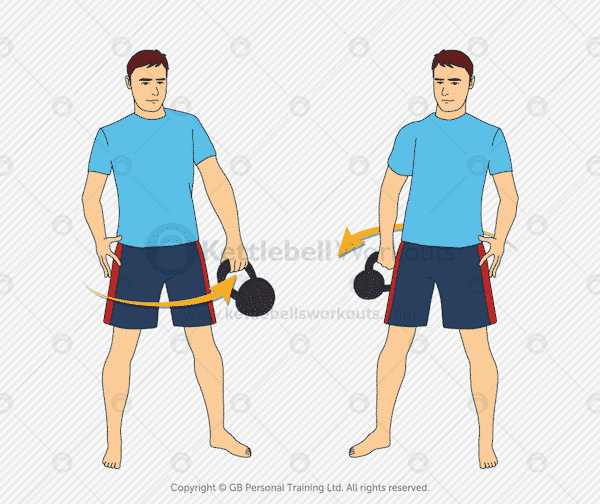
Kettlebell Slingshot
The Slingshot warms up the shoulders and arms and helps you settle into the kettlebell before the harder work starts.
Work: 30 seconds in each direction.
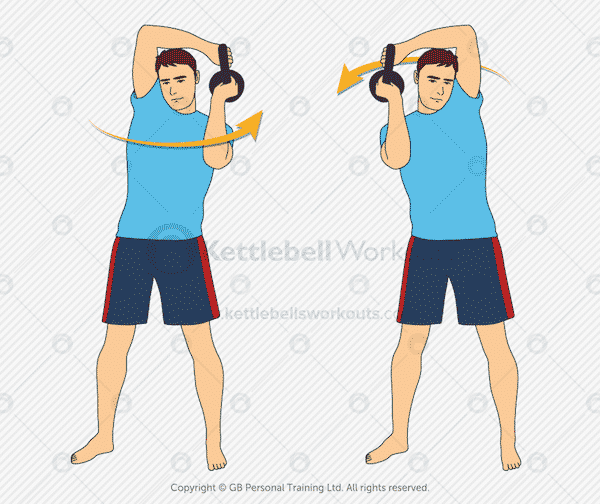
Kettlebell Halo
The Halo mobilises the shoulders, ribcage and upper back while continuing the warm-up.
Work: 30 seconds in each direction.
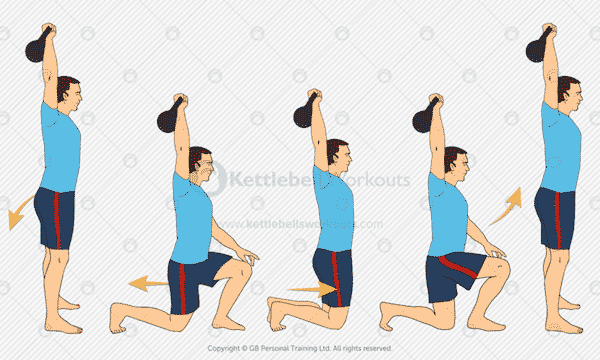
Kettlebell Overhead Warm Up
This movement activates the legs, hips, shoulders and upper back while demanding overhead shoulder stability.
Work: 30 seconds on each side.
Easier option: simply hold the kettlebell overhead for 30 seconds on each side.
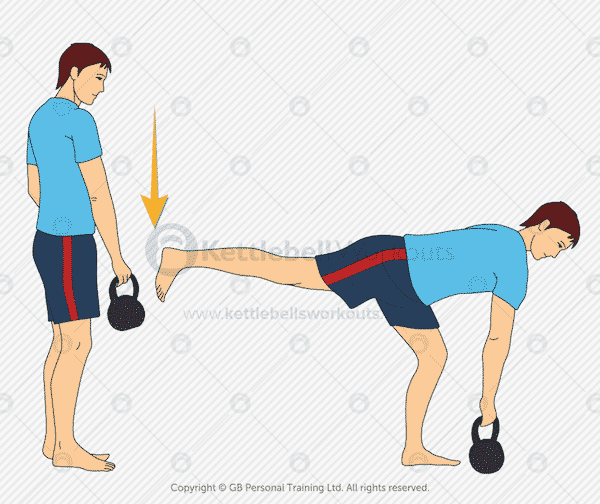
Kettlebell Single-Leg Deadlift
The Single-Leg Deadlift challenges balance, single-leg stability, hip strength and trunk control.
Work: 30 seconds on each side.
Easier option: use the single-arm kettlebell deadlift.
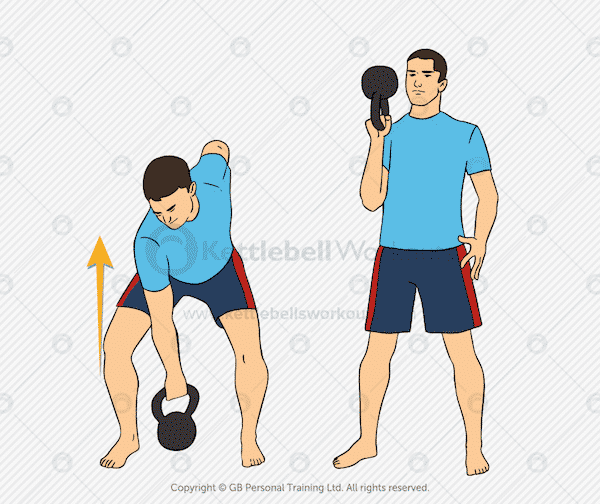
Kettlebell Bottoms-Up Clean
The Bottoms-Up Clean develops grip, alignment and control while still using the hips and legs to create the movement.
Work: 30 seconds on each side.
Easier option: practise the regular kettlebell clean.
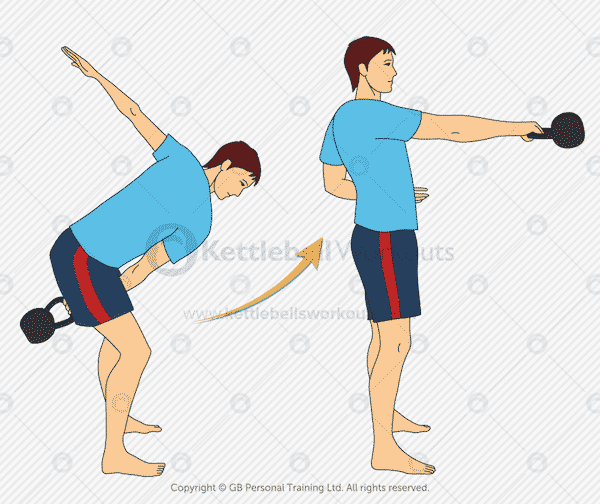
Single-Arm Kettlebell Swing
The Single-Arm Swing introduces the first sustained dynamic effort and heavily involves the posterior chain while challenging grip and conditioning.
Work: 60 seconds on each side.
Easier option: use the two-handed swing.
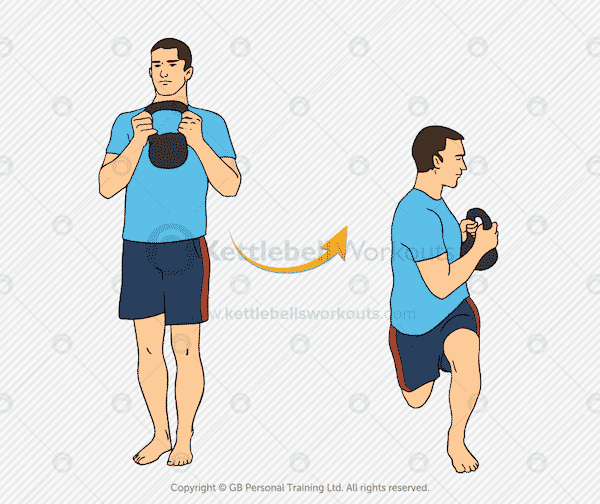
Kettlebell Lunge with Rotation
This lunge variation develops the legs, hips and trunk while adding controlled rotation and a balance challenge.
Work: 60 seconds on each side.
Easier option: remove the rotation and perform a reverse lunge.
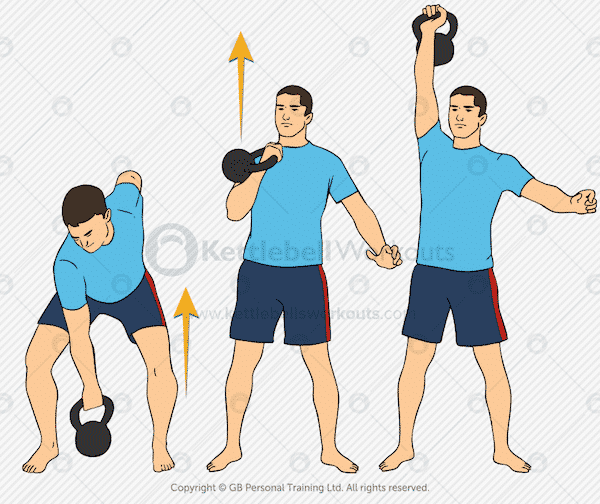
Kettlebell Clean and Press
The Clean and Press combines a hip-driven clean with an overhead press for a demanding full-body strength movement.
Work: 60 seconds on each side.
Easier option: perform only the clean or only the overhead press.
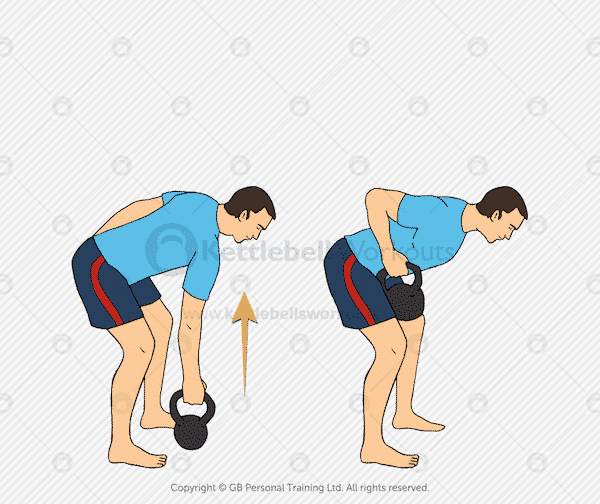
Kettlebell Regular Row
The row targets the back while the hamstrings, glutes and trunk work to maintain the hinged position.
Work: 60 seconds on each side.
Easier option: support one hand on a bench or chair.
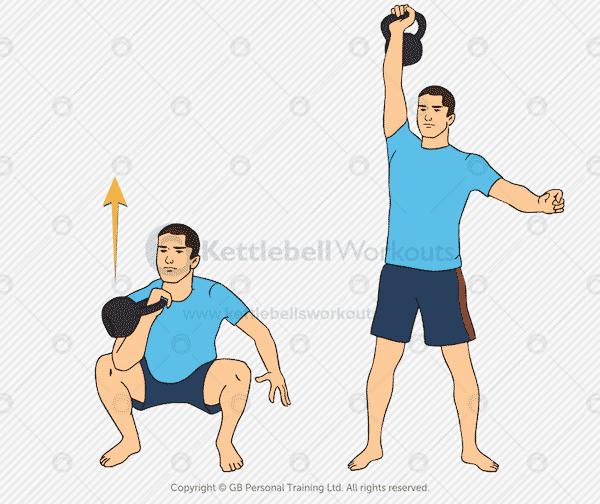
Kettlebell Thruster
The Thruster combines the squat and overhead press, making it one of the most demanding conditioning sections in the workout.
Work: 60 seconds on each side.
Easier option: use a goblet squat, racked squat or reduce the number of overhead presses.
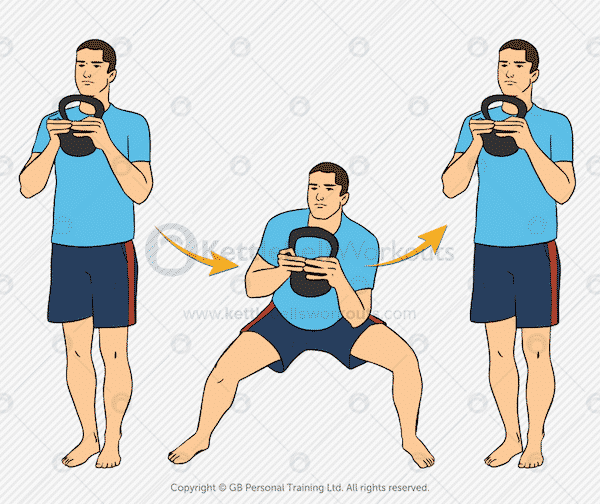
Kettlebell Bob and Weave
The Bob and Weave introduces lateral movement after a long sequence of mostly forward-and-back patterns.
Work: 60 seconds total.
Harder option: use kettlebell side lunges if you already have the mobility and control for them.
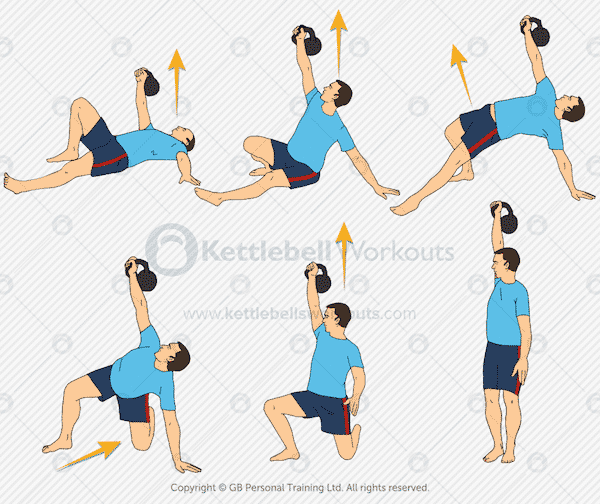
Kettlebell Turkish Get Up
The Turkish Get Up finishes the workout with a slower full-body movement that challenges trunk control, joint mobility and shoulder stability under fatigue.
Work: 2 minutes on each side without the kettlebell touching the floor.
Easier option: use the half Turkish Get Up, moving only from lying to the seated position and back down.
How to Progress This 20 Minute Workout
Do not make this session harder simply by grabbing a heavier kettlebell. First aim to make the transitions cleaner, improve your control on the single-leg and overhead exercises, and reduce unnecessary rest.
Once you can complete the workout with consistently strong technique, you can gradually increase the kettlebell weight or use a more demanding alternative on selected exercises.
I would not use this as a daily workout. It is a relatively long mixed kettlebell session, so give yourself time to recover and balance it with other strength, mobility and cardiovascular work according to your training week.
20 Minute Kettlebell Workout FAQs
Is 20 minutes of kettlebell training enough?
It can be. A well-designed 20-minute session can train multiple movement patterns and challenge both strength and conditioning. Whether it is enough overall depends on your goals, training level and what else you do during the week.
Is this a HIIT kettlebell workout?
Not in the classic work-rest sense. This is a continuous 20-minute challenge with changing exercises and intensities rather than repeated maximal intervals separated by fixed rest periods.
Can beginners do this workout?
I would not use the full continuous version with a true beginner because it contains several technically demanding exercises. Beginners can use the same sequence as a framework, but should take rests and substitute simpler movements where necessary.
How heavy should my kettlebell be?
Choose a kettlebell based on the most technically demanding exercises in the session, not the swing or row. You should be able to control the overhead work, bottoms-up clean and Turkish Get Up without compromising position.
How often can I do this workout?
That depends on your experience, kettlebell weight and the rest of your training. Because this session is full-body and continuous, most people will benefit from recovery before repeating the same challenge.
How many calories does a 20 minute kettlebell workout burn?
There is no useful single number because calorie expenditure varies with body size, kettlebell weight, exercise selection, pace, technique and individual fitness. I would judge the workout by training quality rather than trying to predict an exact calorie total.
Choose Your Workout Length
Short on time? Try the 10 minute kettlebell workout. Want a longer session? Move on to the 30 minute kettlebell workout.


How many calories does this burn?
That depends on too many different things to give you an accurate number eg. weight used, rest periods, genetics, experience etc. Most important is the conditioning, increase in metabolism and also the EPOC.
What are some replacement exercises for lunges… I am not sure that I can do lunges right now, having trouble with my hips after bilateral knee replacement.
No problem Dave, I’ve suggested some here: 5 Alternatives to Lunges for bad knees and toes
Thank you Greg! I usually do your 4 minutes workouts 3 to 4 times, so this looks like the perfect next step.
Yes, there may be a few tricky exercises in there if you are not used to them so take your time and practice the exercises first.