
Last Updated on 10 August 2026 by Greg Brookes
You can train your chest with kettlebells, but I would not choose kettlebells as my first tool if maximum chest development was the goal.
The chest is primarily trained with horizontal pushing movements. To develop the pectoral muscles well, I want an exercise that lets the upper arm travel far enough behind the torso to create a useful stretch under load.
That is where kettlebells become slightly awkward. A Floor Press stops when your upper arm reaches the floor, while a bench press with dumbbells or a barbell gives you a much larger range of movement.
So rather than pretending every kettlebell press is a great chest builder, below are the kettlebell chest exercises I think make the most sense, plus the situations where another tool is simply better.
The Short Answer
If you train at home: use Push Up variations as your main chest exercise. A standard Push Up works well, and placing 2 kettlebells securely on their sides can increase the available depth without relying on unstable upright handles.
If chest growth is a major goal and you have access to a bench: dumbbell or barbell bench pressing is generally a better choice because you can load the horizontal push heavily while still taking the chest through a larger range of motion.
What the Chest Muscles Actually Do
The main chest muscle is the pectoralis major. It helps bring the upper arm across the body and contributes strongly to horizontal pushing movements such as Push Ups and Bench Presses.
The smaller pectoralis minor sits underneath and assists with movement and control of the shoulder blade.

Why Range of Motion Matters for Chest Growth
For muscle development, I prefer exercises that load the chest through a useful range rather than stopping the movement early.
There is growing research interest in resistance training performed at longer muscle lengths. Recent reviews suggest that training a muscle in a more lengthened position may be beneficial for hypertrophy, although the evidence is not completely uniform.
That does not mean you need an extreme stretch. It means that, all else being equal, I would rather choose a chest exercise that lets the upper arm move below the level of the torso than one where the floor stops the movement prematurely.
Research: resistance training at longer muscle lengths and hypertrophy
5 Kettlebell Chest Exercises I Prefer
Deficit Push Up Using 2 Kettlebells
Lay 2 stable kettlebells securely on their sides and use them as raised hand supports for your Push Ups.
Because the kettlebells are lying on their sides, they cannot tip over in the same way as upright bells. The raised hand position also allows your chest to travel lower than your hands, giving you a greater range of motion and more stretch through the pectoral muscles.
Why I like it: it keeps the simplicity of the Push Up while increasing depth, without introducing the instability problem you get when supporting yourself on upright kettlebells.
Feet-Elevated Push Up
Elevating the feet increases the load through the upper body and makes a normal Push Up considerably harder.
This is one of the simplest ways to progress chest training at home without needing heavier weights or unstable equipment.
Use it when: standard Push Ups have become too easy but you still want a straightforward bodyweight option.
Kettlebell Bench Press
If kettlebells are the weights you own but you also have a bench, you can perform a normal horizontal Bench Press with them.
This removes my main objection to the Floor Press because the elbows can travel below the torso and the chest can work through a larger range.
However: if I had equal access to dumbbells, I would usually choose dumbbells for dedicated chest hypertrophy because they are easier to position, progress and load for pressing.
Close-Grip Kettlebell Push Up
Place both hands securely on a single stable kettlebell and perform a close-grip Push Up.
This variation increases the demand on the triceps while still providing useful chest work. I see it as an alternative pressing variation rather than my first choice for maximising pectoral growth.
 Close-Grip Kettlebell Push Up
Half Get Up Press
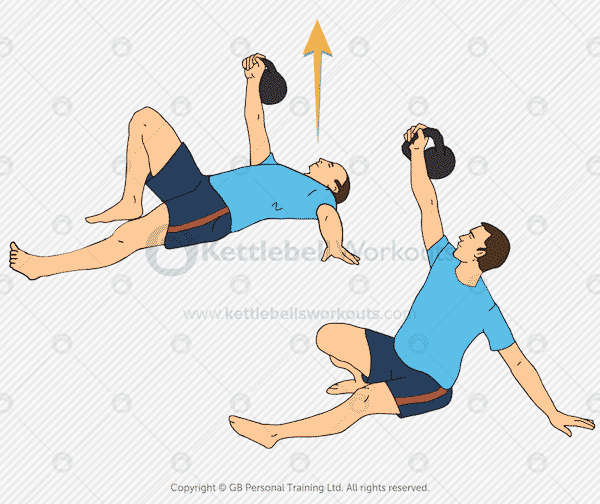
The Half Get Up Press combines a press with shoulder stability and trunk control.
I would not choose it as a primary chest-building exercise, but it can provide some horizontal pressing work while also developing whole-body control.
Think of it as: a useful kettlebell pressing exercise with chest involvement, rather than a dedicated hypertrophy movement.
Advanced Kettlebell Push Up Variation
Push Up to Renegade Row
The Push Up to Renegade Row combines pressing, rowing and anti-rotation work, but you are supporting your body on 2 upright kettlebells and shifting your weight from side to side.
That makes it significantly more advanced than a normal Push Up or a deficit Push Up performed with kettlebells laid safely on their sides.
 Push Up to Kettlebell Renegade Row
I include it here simply as an example of what is possible with kettlebells. It is not necessary for chest development, and I would not put it into a general chest workout.
What About the Kettlebell Floor Press?
The Floor Press is probably the exercise most people expect to see first in a kettlebell chest article.
I do not use it as my primary chest-building exercise.
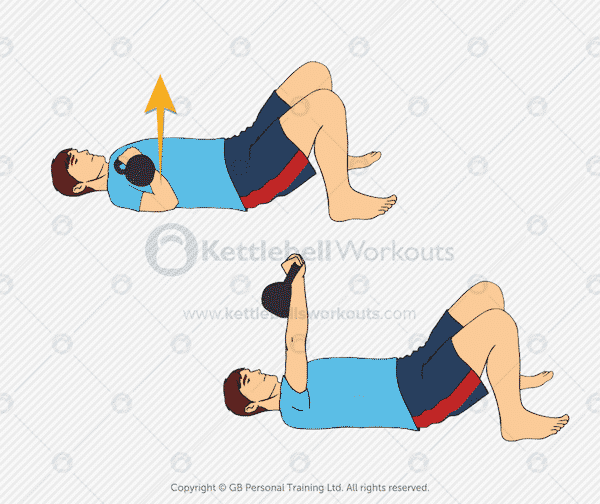
The problem is not that the Floor Press does nothing. It clearly trains the pressing muscles. The problem is that the floor stops the elbow and reduces the bottom portion of the movement, which is exactly where I would prefer to keep more range available for the chest.
The Floor Press can still have a role when you deliberately want a shorter range, need a stable pressing position or are programming around an individual’s shoulder tolerance. I simply would not present it as the best kettlebell exercise for growing the chest.
What About the Half Get Up Press?
The Half Get Up Press is a useful kettlebell exercise, but I regard it as a whole-body stability exercise with a press, not a dedicated chest-building exercise.
Kettlebells vs Push Ups vs Bench Press for Chest
| Exercise | Chest Range | Easy to Progress? | My Use |
|---|---|---|---|
| Deficit Push Up on Side-Positioned Kettlebells | Very good | Excellent | Best kettlebell-specific chest option |
| Dumbbell / Barbell Bench Press | Very good | Excellent | Best choice when chest growth is the priority |
| Kettlebell Bench Press | Very good | Reasonable | Useful if kettlebells are your available weights |
| Standard Push Up | Good | Yes | Excellent general chest exercise |
| Kettlebell Floor Press | Limited at the bottom | Yes | Useful selectively, not my preferred chest builder |
Simple Kettlebell Chest Workout
If you train at home and kettlebells are your main equipment, I would keep the chest work simple rather than trying to invent lots of unusual kettlebell presses.
- Deficit Push Ups using 2 kettlebells laid securely on their sides: 3-4 sets of 6-15 reps
- Feet-Elevated Push Ups: 3 sets of 6-15 reps
- Close-Grip Kettlebell Push Ups: 2-3 sets of 6-12 reps
Stop each set when your technique or range starts to deteriorate. Progress by adding repetitions, elevating the feet, slowing the tempo or adding external load rather than simply collecting more exercise variations.
The Bigger Picture
Kettlebells are excellent for Swings, Cleans, Presses, Rows, Squats, Lunges, Carries and full-body conditioning. The chest is one area where I think it is useful to be honest about the limitations of the tool.
That does not mean you cannot build a strong chest while training with kettlebells. It means you should choose the horizontal pushing movement intelligently rather than forcing every exercise to involve a kettlebell.
For most home trainees, a good Push Up progression solves the problem beautifully.

Related Kettlebell Training
Frequently Asked Questions
Can you build your chest with kettlebells?
Yes, provided your programme includes a challenging horizontal pushing movement. However, if maximum chest growth is the priority, Push Ups with increased range of motion or Bench Press variations are generally more practical than relying on Floor Presses alone.
What is the best kettlebell chest exercise?
If you do not have a bench, my favourite kettlebell-specific option is a deficit Push Up using 2 kettlebells laid securely on their sides. This gives you extra depth without relying on unstable upright handles. A standard Push Up is still an excellent simpler alternative.
Are kettlebell Floor Presses good for the chest?
They do train the chest, triceps and shoulders, but the floor limits the bottom range of movement. I therefore prefer Push Ups or a proper Bench Press when chest development is the main objective.
Can I train my chest with one kettlebell?
Yes. You can use a single kettlebell for close-grip Push Ups or pressing movements, although I would still prioritise a stable, full-range horizontal push. Uneven Push Ups with one hand on a kettlebell are better treated as an optional progression for experienced lifters.
What if I only own one kettlebell and have no bench?
Use standard Push Ups as your foundation, then add uneven kettlebell Push Ups, feet-elevated Push Ups and other Push Up progressions as you become stronger.
Do kettlebell Swings work the chest?
Not to any meaningful degree for chest development. The Swing is primarily a hip-dominant exercise. If you want to train the chest, add a genuine horizontal pushing movement.


Comments