
Last Updated on 13 August 2026 by Greg Brookes

Single leg kettlebell exercises develop much more than leg strength. They challenge balance, hip control, trunk stability and the ability to transfer force through 1 side of the body at a time.
They are also useful because walking, running, climbing stairs and many sporting movements repeatedly place most of your weight on 1 leg. You do not need to replace bilateral Squats and Deadlifts, but adding some unilateral work gives you a different challenge.
Below are 5 single leg kettlebell exercises, from the relatively accessible Single Leg Deadlift and Bulgarian Lunge through to the much more demanding Single Leg Clean and Pistol Squat.
5 Benefits of Single Leg Kettlebell Exercises
Single-leg training gives you several qualities that are harder to reproduce when both feet are sharing the load equally.
Single Leg Training and Coordination
Single-leg exercises demand more coordination than their 2-leg equivalents because you are managing balance, joint position and the kettlebell at the same time.
If balance or skill is the main goal, place your most demanding single-leg exercise reasonably early in the session while you are fresh. That does not mean every single-leg exercise must always come first, or that your nervous system needs unusually long recovery simply because you trained on 1 leg.
Progress the difficulty only when you can maintain control. A heavier kettlebell is not an improvement if the exercise becomes a succession of balance corrections.
5 Single Leg Kettlebell Exercises
Start with bodyweight or a light kettlebell where necessary. The first 2 exercises are appropriate starting points for most people, while the final 3 require progressively more skill.
Kettlebell Single Leg Deadlift
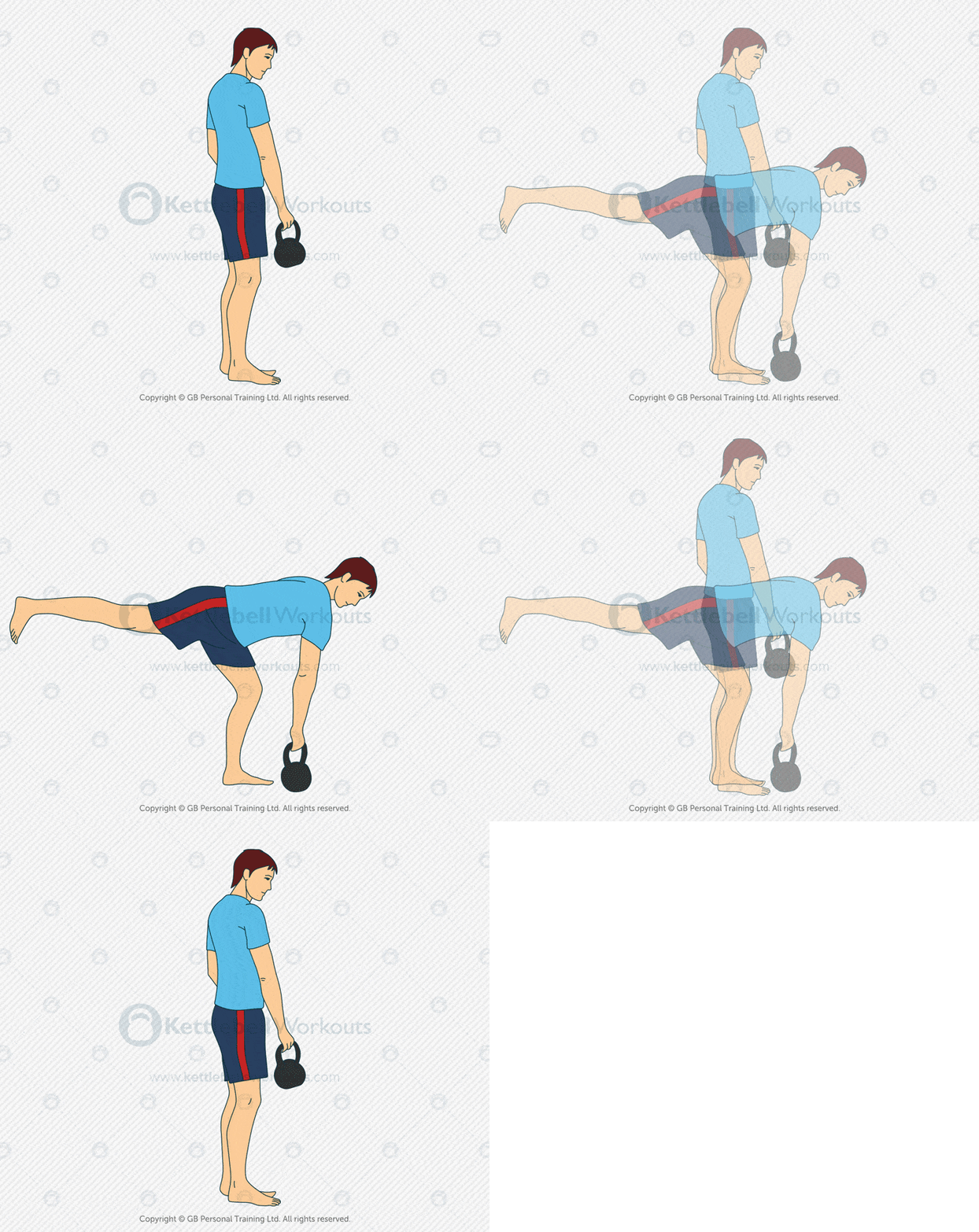
Best for: hip strength, balance and cross-body trunk control.
The Single Leg Deadlift is the foundation exercise on this page. You hinge on 1 leg while the free leg travels behind you, so the hips and trunk have to control both balance and rotation.
Hold the kettlebell in the opposite hand to the standing leg. Keep the pelvis as level as you comfortably can and think about reaching the free leg backwards rather than simply dropping the kettlebell towards the floor.
Start with: 5 to 8 controlled reps per side.
Kettlebell Bulgarian Lunge
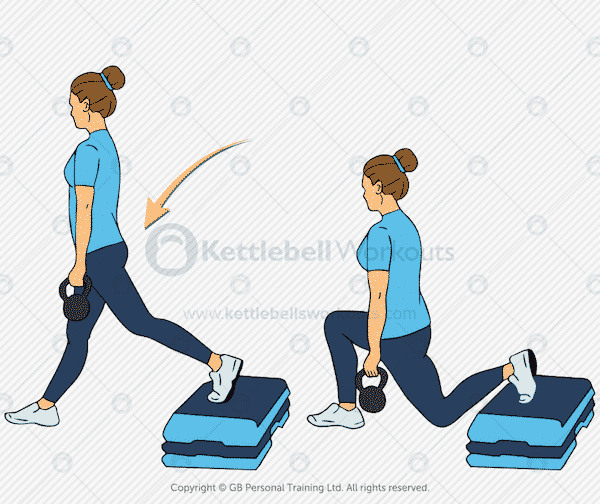
Best for: single-leg strength with more external stability than a true 1-leg squat.
The Bulgarian Lunge, or rear-foot-elevated split squat, is a useful bridge between 2-leg squatting and more demanding single-leg work. Most of the load stays on the front leg while the rear leg provides support.
Use a low rear-foot support at first and choose a stance that lets the front foot stay firmly planted. You can hold 1 kettlebell or 2, but bodyweight is a perfectly good starting point.
Start with: 6 to 10 reps per side for 2 to 3 sets.

Kettlebell Single Leg Clean

Best for: power, balance and controlling a moving kettlebell on 1 leg.
This is an advanced progression of the regular Kettlebell Clean. The bell is moving dynamically while you have only 1 foot on the floor, so good Clean technique should already be automatic before you add the single-leg challenge.
Keep the standing foot active, brace before the Clean and use the free leg naturally for balance. There is no need to add an overhead press unless the Clean itself is already stable and repeatable.
Start with: 5 to 8 reps per side with a light kettlebell.
Kettlebell Single Leg Row
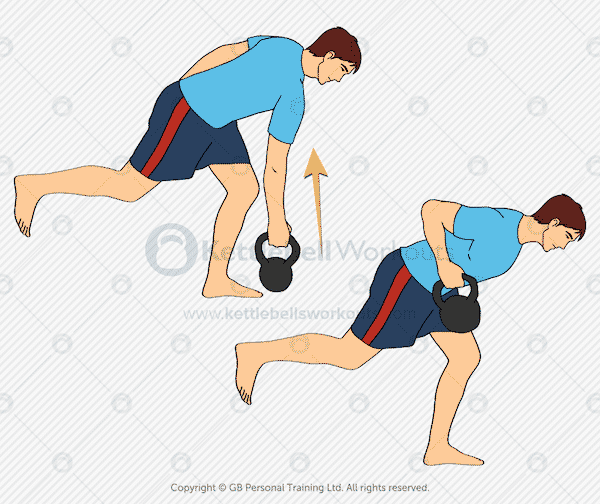
Best for: upper-back strength with anti-rotation and single-leg control.
The Single Leg Row combines a hip-hinge position with a pulling exercise. Holding the weight opposite the standing leg creates a diagonal rotational demand through the trunk.
Keep the hips controlled and pull the elbow towards the hip without twisting the torso to finish the repetition. If balance prevents you from challenging the back muscles, use a supported Row instead and train balance separately.
Start with: 5 to 10 slow reps per side.
Kettlebell Pistol Squat
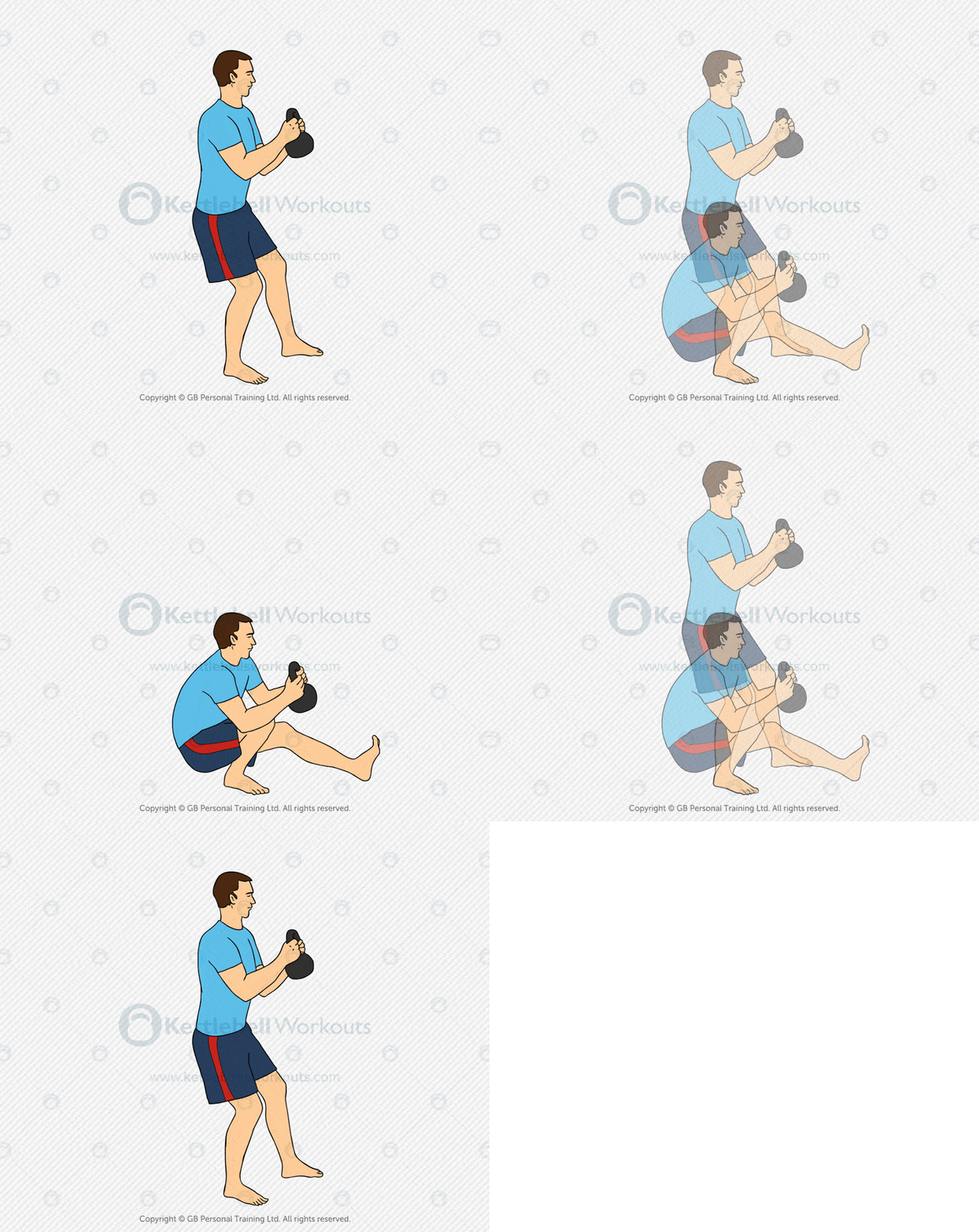
Best for: high-level single-leg strength, mobility and balance.
The Pistol Squat is the most demanding exercise in this guide. The kettlebell acts as a counterbalance while 1 leg controls the full squat, so ankle mobility, hip control and leg strength all matter.
Do not use the Pistol as your starting point for single-leg training. Build the pattern through supported squats, step-downs and easier single-leg variations first.
Start with: 1 to 5 high-quality reps per side.
Simple Single Leg Kettlebell Workout
You do not need to combine all 5 exercises in 1 session. For most people, 3 well-chosen movements are enough to train a single-leg hinge, knee-dominant strength and trunk control.
Complete 2 to 3 rounds, resting enough to keep the balance and technique clean. Use support for the Deadlift or Row if that lets you train the muscles more effectively.
More advanced kettlebell users can occasionally substitute the Single Leg Clean or Pistol Squat, but I would not add them simply to make the workout look harder.
How to Progress Single Leg Kettlebell Training
The best progression is not always less support. You can also improve by increasing the kettlebell load, slowing the lowering phase, increasing the range of motion or completing more controlled repetitions.
For most people I would build around the Single Leg Deadlift and Bulgarian Lunge first. Add the Single Leg Row when you can hold a stable hinge, then use the Single Leg Clean and Pistol Squat only when your technique justifies the extra complexity.
Single-leg work should complement your regular Kettlebell Squats, Deadlifts and Swings rather than replacing them altogether.
Related Kettlebell Guides
Use these guides to develop the main movement patterns further:
Frequently Asked Questions
What is the best single leg kettlebell exercise?
The Single Leg Deadlift is the best starting point for most people because it develops hip strength, balance and trunk control without requiring the mobility of a Pistol Squat or the skill of a Single Leg Clean.
Are single leg kettlebell exercises good for balance?
Yes. They reduce the base of support and require the foot, hip and trunk to continually control your position. You can still use light external support when you want strength rather than balance to be the main challenge.
Should I hold the kettlebell on the same or opposite side?
Both can be useful. Holding the kettlebell opposite the working leg usually creates a stronger cross-body and anti-rotation challenge, while same-side loading changes the balance demand.
Do single leg exercises fix muscle imbalances?
They can help each side develop more independently and make side-to-side differences easier to notice, but small differences are normal. Train both sides well rather than trying to make every measurement perfectly symmetrical.
How often should I train single leg exercises?
For most people, including 1 or 2 single-leg movements in 2 to 3 weekly strength sessions is plenty. The amount depends on your overall programme, recovery and goals.


Comments