
Last Updated on 10 August 2026 by Greg Brookes

The kettlebell swing is a ballistic hip-hinge exercise. The hips generate the power, the arms guide the kettlebell, and the body repeatedly moves between a loaded hinge and a strong upright position.
It is one of the most important kettlebell exercises to learn because a good Swing develops the same hip-hinge pattern that sits underneath many other kettlebell movements.
This guide focuses on the two-handed Russian kettlebell swing, where the kettlebell travels to roughly chest height rather than overhead. I’ll show you how to perform it, what muscles it works, the main benefits, the mistakes I see most often and how to progress once your form is solid.
The Most Important Thing to Understand
The Swing is not a squat with the kettlebell being lifted by the shoulders.
You hinge at the hips, load the glutes and hamstrings, then drive the hips forwards. That hip extension gives the kettlebell its momentum. At the top, the bell should briefly float before gravity brings it back towards the hinge.
Think hips, not arms. If your shoulders are doing most of the work, the Swing has become a front raise rather than a hip-powered movement.
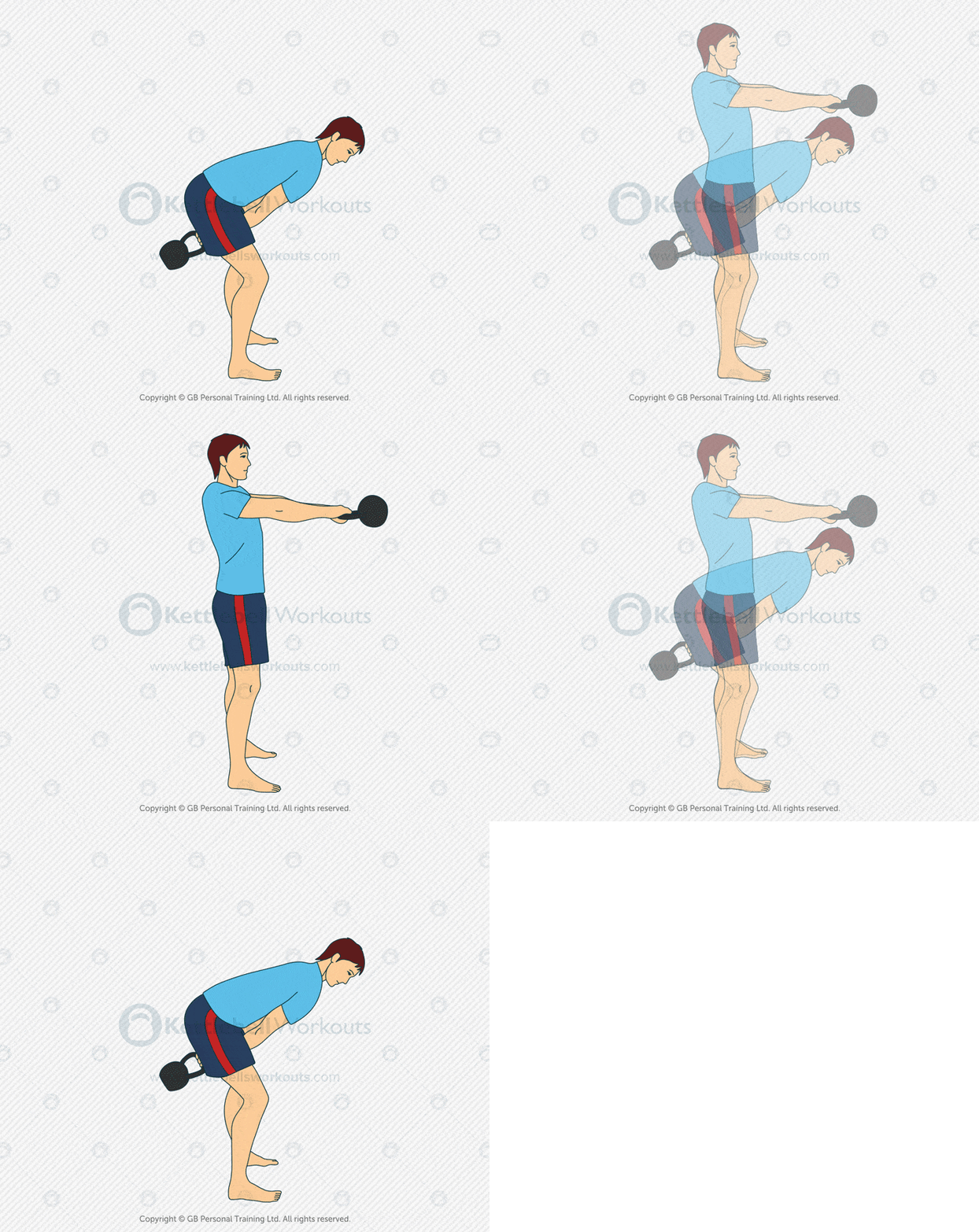
How to Do a Kettlebell Swing
Kettlebell Swing Setup at a Glance
Kettlebell Swing Muscles Worked
The two-handed Swing is primarily a posterior-chain exercise. The legs, hips, trunk and upper body all contribute, but they do not all have the same job.
The glutes drive the hips forwards and create much of the power at the top of the Swing.
The hamstrings load during the hip hinge and work with the glutes to extend the hips.
The muscles around the spine help maintain position as the kettlebell moves through the hinge.
The abdominal muscles brace as the body moves between the hinge and upright position.
The lats help keep the shoulders connected and control the kettlebell as it travels back between the legs.
The hands and forearms control the handle throughout the repeated acceleration and deceleration.
For a broader look at training the midsection with kettlebells, see my kettlebell core exercises.
Kettlebell Swing Benefits
The reason I place such a high value on the Swing is that one exercise can train several qualities at once without needing much space or equipment.
The fast hip extension teaches you to generate force from the hips rather than slowly lifting the kettlebell.
Repeated hinging trains the glutes, hamstrings and back while reinforcing the hip-hinge pattern.
Continuous Swing sets quickly raise the heart rate, which is why the exercise works well in intervals and circuits.
The trunk has to brace as the kettlebell accelerates away from and back towards the body.
The Swing reinforces strong hip extension while the lats, back and core control the body around the moving load.
You need only a kettlebell and a small amount of clear floor space to train strength and conditioning together.

Proper Kettlebell Swing Form
Once you understand the basic movement, these are the coaching points I use to refine the Swing.
Place the kettlebell in front so you have room to hinge and hike it back with intent.
Send the hips backwards. The knees bend, but they should not dominate the movement.
Avoid rounding as the kettlebell travels between the legs.
Keep the shoulders away from the ears and use the lats to connect the arms to the torso.
You need control, not a crushing grip. Excess tension often spreads into the forearms and shoulders.
The hip drive creates the movement before the arms rise.
The kettlebell does not need to be actively lifted to chest height.
Let the head follow the spine rather than forcing the eyes forwards throughout the hinge.
Finish tall through the hips and trunk without leaning backwards.
Wait for the kettlebell to return before pushing the hips back.
The handle should pass high between the legs rather than dropping down towards the floor.
Match the breath to the rhythm and load rather than holding your breath randomly.
Decelerate the final Swing and park the kettlebell in front under control.
Master the Hip Hinge First
If the hinge is not clear, the Swing usually becomes a squat, a shoulder raise or a mixture of both.
Practise pushing the hips backwards while keeping the kettlebell close to the body. Once you can load the hamstrings and return to standing through the hips, the ballistic Swing becomes much easier to understand.
The kettlebell deadlift is the simplest loaded exercise to practise before the Swing.
14 Common Kettlebell Swing Mistakes
Most Swing problems come from losing the hip-hinge pattern, mistiming the kettlebell or creating unnecessary tension. These are the 14 mistakes I see most often.
How High Should You Swing the Kettlebell?
For the two-handed Russian Swing, roughly chest height is enough.
The height is an outcome of the hip drive, not the goal of the exercise. A lighter kettlebell or stronger hip snap may make the bell float higher. A heavier bell may not rise as far.
Kettlebell Swing Breathing
Your breathing should support the rhythm and the amount of load you are using.
A continuous breathing rhythm works well. Keep the breath coordinated with the repeated movement rather than holding it unnecessarily.
Use a stronger brace through the hinge and a forceful exhale as you reach the top position.
The important point is consistency. Your breathing should help you maintain trunk control and rhythm rather than disrupt it.
How to Start and Stop a Swing Set
The Swing should not begin with the kettlebell hanging underneath you.
Set the bell slightly in front, hinge down and grip the handle. From there, hike the kettlebell back between the legs so the first repetition begins with the hips loaded.
To finish, let the last Swing return, absorb it into the hinge and then guide the kettlebell forwards to the floor. Do not simply release tension and let the kettlebell pull you out of position.
What Kettlebell Weight Should You Start With?
The current starting ranges I use as broad reference points are:
Women: 8-12kg
Men: 12-16kg
These are not rules. Training experience, body size, strength and movement quality all matter.
A kettlebell that is too light can encourage you to lift with the arms, but a bell that is too heavy can pull you out of the hinge and make the timing difficult to control.
Choose a weight that makes you use the hips while still allowing every repetition to look the same.

Kettlebell Swing Progression in 4 Steps
Once the two-handed Swing is technically solid, I like to progress complexity and load gradually rather than changing everything at once.
If you are not ready for a full Swing yet, establish the kettlebell deadlift and hip hinge first.
Kettlebell Swing Variations
The two-handed Swing is the foundation. Once that movement is strong, variations can increase the grip, core, coordination or movement challenge.

Russian vs American Kettlebell Swing
The kettlebell is driven by the hips and normally rises to around chest height. This is the version I teach as the standard Swing.
The kettlebell continues overhead. That adds an overhead shoulder position that is not necessary for learning the basic hip-powered Swing.
For most people learning kettlebells, I prefer to establish a powerful Russian Swing first rather than using extra arm and shoulder movement simply to take the bell higher.
Two-Handed vs One-Handed Kettlebell Swing
The mechanics remain based on the same hip hinge, but using one hand increases the demand on the grip, shoulder and trunk because the load is no longer symmetrical.
That is why I teach the two-handed Swing first. Once you can produce repeatable hip power without being pulled forwards or twisting, the one-handed Swing becomes a logical progression.
How to Use Kettlebell Swings in a Workout
Swings can be used for conditioning, within a strength circuit or as a short finisher. The exact dose depends on your experience and the rest of the session.
30 seconds two-handed Swings
30 seconds rest
Repeat for 6-10 rounds.
10 Swings
5 Goblet Squats
Repeat for 5 rounds.
20 Swings at the start of each minute for 10 minutes, resting for the remainder of each minute.
Use shorter sets and more rest when the priority is improving the movement rather than accumulating fatigue.
What Comes After the Kettlebell Swing?
The Swing creates the ballistic hip power used in more advanced kettlebell exercises. Once the basic movement is reliable, the Clean and Snatch become much easier to understand.
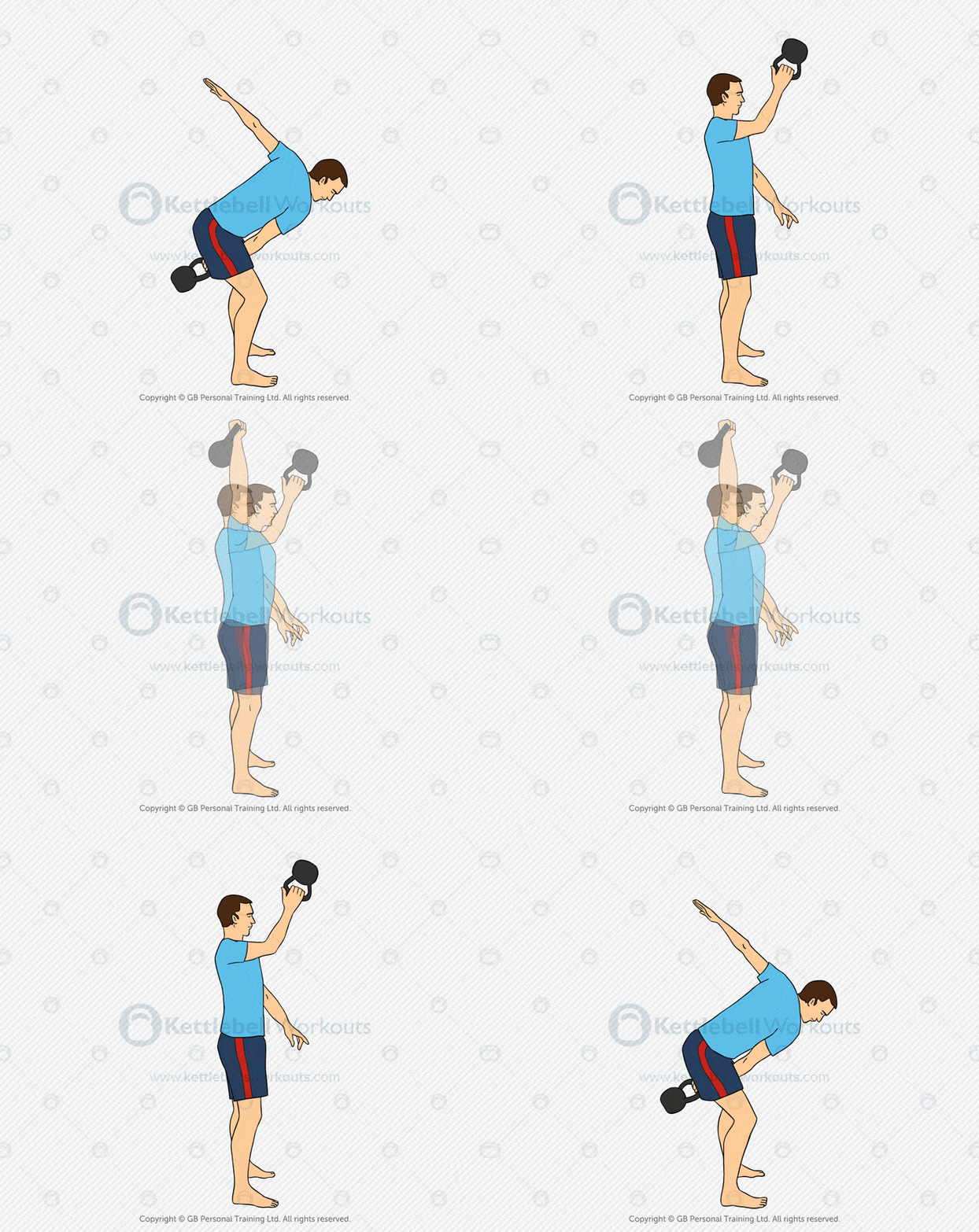
Frequently Asked Questions
What is the correct kettlebell swing form?
Use a hip hinge rather than a squat, maintain a controlled spine, drive the hips forwards and let the kettlebell float. The arms guide the bell rather than lifting it.
What muscles do kettlebell swings work?
The Swing mainly trains the glutes, hamstrings and back, with the core, lats, grip and shoulder stabilisers helping to control the moving kettlebell.
What are the benefits of kettlebell swings?
Swings combine explosive hip power, posterior-chain training, trunk stability and conditioning in one exercise that requires little space.
What is the difference between a Russian and American Swing?
The Russian Swing normally finishes around chest height, while the American Swing continues overhead. I use the Russian Swing as the standard version for learning hip-driven technique.
Are kettlebell swings bad for your back?
The Swing should be driven from a controlled hip hinge. If you round the back, lose the hinge or use more weight than you can control, the exercise needs to be regressed and the technique corrected.
Can kettlebell swings be used for cardio?
Yes. Repeated Swing intervals can raise the heart rate quickly, which is why the movement works well in conditioning circuits and EMOM workouts.
How often should I do kettlebell swings?
The current article uses 2-5 sessions per week as a broad range, but frequency should depend on the volume, load, your experience and the rest of your training.
Can kettlebell swings build muscle?
Swings train the glutes, hamstrings and back strongly, but they are a ballistic exercise rather than a conventional bodybuilding movement. They work best as part of a broader strength programme when muscle growth is the main goal.
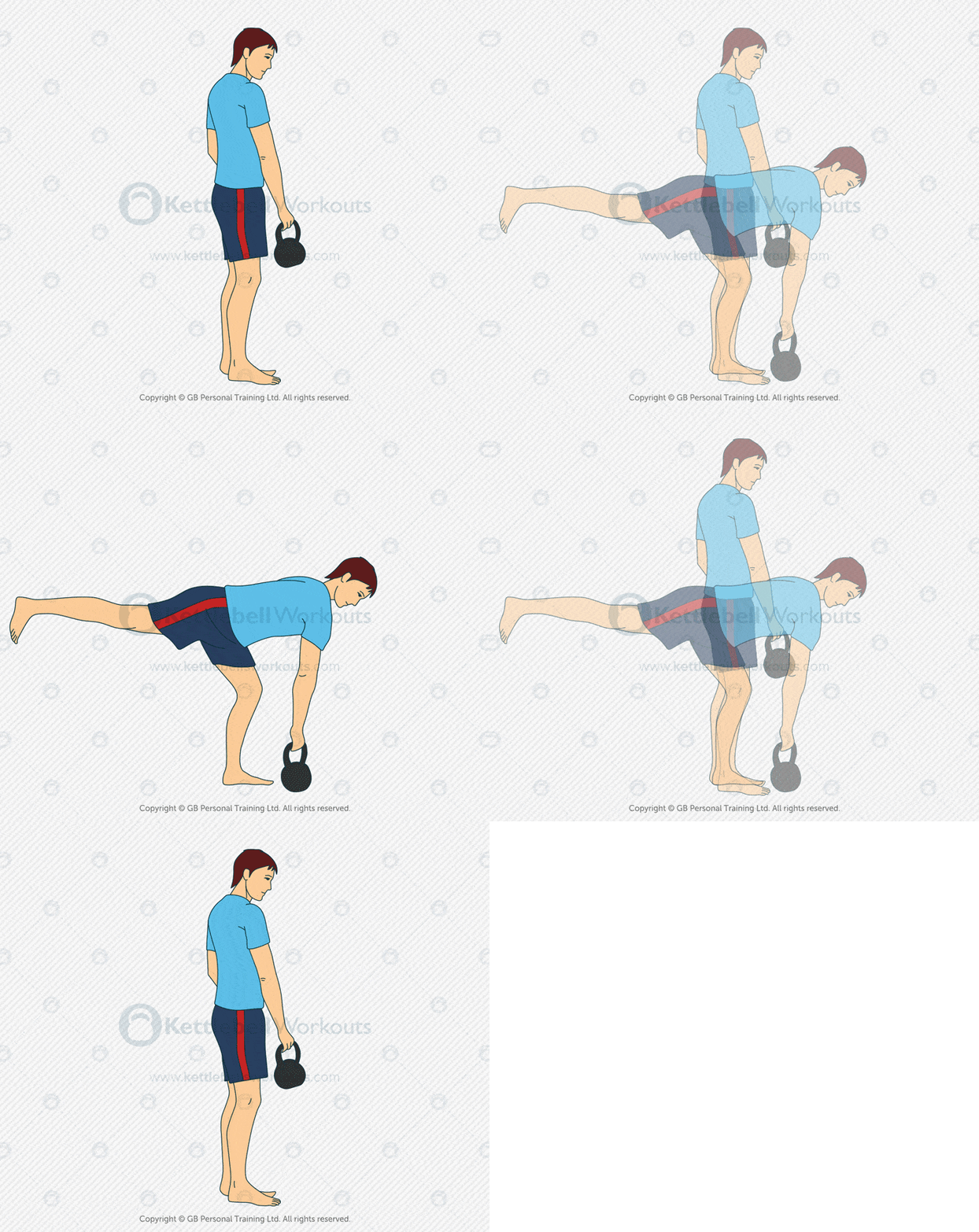

How many reps should you do?
One thing that really helps me keep my back flat is waiting to hinge until the last possible moment. I’ve seen it described as “playing chicken with your man (or lady) parts”, and that’s a good description. I find that if I anticipate the hinge, my back tends to bend. The shorter and quicker (in duration) the hinge movement, the more likely I am to keep a nice flat back.
I love the movements and the advice you give. I enjoyed reading this article very much, very detailed and will put it to practice!
I’m a beginner. Thanks!
Hi Greg,
What a great job!
At 49, I decided to resume functional training after two years of Calisthenics and 6 months of injury.
I was looking for a structured environment to start with Kettlebells. Hre, we can find beautiful and serious compilation work. A great thanks you for this precious sharing. On the other hand, I can not get the free booklet of 10 Best Kettelbell Workout, before paying for your other courses as excellent I guess … Ave you any idea ?
Have a nice days !
From France
Thanks Tony, yes you can click the image on the right of this page to download my free kettlebell workouts.
Excellent site, and comprehensive instructions! Many thanks from this kettlebell newbie 🙂
Mr. Brookes I hereby crown you The Kettlebell King. Excellent tutorials. You are very generous with your information and your time. Thank you.
Now I will begin the New Year with a great exercise plan and routine.
Thanks Bill, you are too kind.
Hi Greg !
I’ve been following this tutorial, which is quite good, indeed, but, have had some concerns :
Have had a little (not strong) pain at the lower back. However the pain is alongside the vertebral column, not “inside” or in the middle of ti. I have herniated disc (not a big issue) and I know this pain from KB training is different.
Could this pain be regarded to some muscles involved ? Maybe erector spinae or something like that ?
Other than that I DO feel my glutes somewhat sore, as well as my hamstrings and this is a proof that I’m doing swings correctly, I guess…
Ops, and another thing : I have a great difficulty on keeping my belly button tucked IN, mostly when the KB is on the lower back phase. Any hint for that ?
Hi Greg !
Live in Brazil and, even though there are many, many gyms (almost one per quarter – brazilians are very “body aesthetics oriented”) they’re mostly traditional weight lifting/treadmills ones. There are many Cross Fit boxes as well. On the other hand, there are almost no certified KB instructors. There are KBs here and there of course, but this is not mainstream yet.
Your site/material is very nice indeed but, I miss, at least at first, to be “watched” by an experienced “kettlebeller”.
I’m very, very concerned with good technique (as I also do Pilates, this is one of their concepts too : precision).
Have you thought about, or know someone who, can offer a kind of online tuition ? Either by watching the student perform the exercises live/real time or , by reviewing recorded videos that are sent weekly via WhatsApp for instance ?
Thanks in Advance !
Great to hear from you Jose, yes I already offer this kind of service to those who purchase my kettlebell programs. If any of my students are unsure of their technique they send in a video and I send feedback via email. If there is anything that you want help with then just send me an email and I’ll be happy to help.
Just started this again as have been ill suffering from hyperthyroidism .I virtually ache everywhere ,have a bad back and knees which tend to come and gowns and feel like I’m fighting weight gain . Back and knees hurt today but I have done all beginner exercises ok.No doubt I’ll ache tomorrow! but not giving up . I have plantar fasciitis so my normal running , aerobics is out of the question thanks for these great exercises I know they’ll help.
Great article!
What would you advise as sets and reps for a distance runner who wants the benefits of strength, power and injury resilience but without the likelyhood of hypertrophy as I want to stay light and fast but powerful.
Currently doing 2 sessions a week.
Also what would be a great superset pairing? Pull-ups for total back workout?
Sure Richard, take a look at this article on kettlebell training for runners.
Hi Greg, I was taught that shoulders should not go in front of the knees. However your shoulders go quite a bit in front. Can you comment on that? Thanks!
I’m not sure why you would have been told this Kamen, it seem almost impossible to put the body into any deadlift position without the shoulders moving slightly in front the the vertical knee line. The upper body has to counterbalance the movement of the hips going backwards otherwise you would be off balance.
Hi Greg, great page and instruction on kettleb exercises. Thank you for sharing.
I just did the two hand swing (with 12kg; being female, 60kg, 162cm) for the first time and all I could do was 20 swings (with a short break halfway to shake everything out) and then my inner thighs/hamstrings felt like they were about to cramp hard, so I immediately stopped and kicked/shook my legs out lying on my back and stretching them out. Afterwards my inner thighs and hams were really sore (also today) like I had never done leg stuff before (not true).
I know you said it’s normal for me to be sore but was wondering do you have any advice on how to cool down the leg muscles effectively to avoid injury right after swings? I was kicking and shaking them out like a dreaming dog in a bit of a panic as they were still kind of seizing up even as I was shaking/kicking/stretching and hoping “please please don’t let me have hurt myself”. I’m also a bit worried that they seized that much as I’m reasonably active and my legs/hips are quite strong (I ride 10ks to work and back each day, I do some aerobic exercises semi regularly involving different squats, I used to do kungfu and taichi which was all about a strong low stance and I still do stretches and kicks as warm up exercises for 10 mins and I can kick and hold, kick over my head no problem).
I feel like I should be able to do more than 10×2 but I don’t want to strain myself and not be able to do anything at all for a while -_- any advice would be appreciated.
Finally, can one do the lateral swing holding on with 2 hands, or does it have to be 2?
Sorry for long post, I’d embed image of potato at end if I could, but alas. Thank you.
You could use KB deadlifts as a cool-down (I have very poor hamstring mobility and use them as a loaded stretch late in my workout). Probably holding back from “max effort” would be safe as you get used to things.
Also, I’d wait to try a lateral swing til you have a good feel for how the kettlebell’s momentum pulls on your torso.
JY, kettlebell swings have a very high loaded eccentric part to them during the down swing as you absorb and then reverse the load. Eccentric loading (or the lowering phase) has been shown to be the main course of delayed onset of muscular soreness (DOMS). My best advice would be to warm up with a lighter kettlebell or even practice without the kettlebell before moving up to the 12kg. Keep your reps short to start, sets of 10 and then add a few extra each day or 2. With time you will not feel the DOMS but still get all the benefits 🙂
Hi Greg – thanks for comprehensive KB swing article! Is there any particular point you would emphasise re the swing – in avoiding lower back pain, which has long been something I have experienced on and off?
Lower back pain not there at present but I want to be sure about not doing anything to trigger it!
Thanks John, I’ve listed some points above but a common problem is leaning backwards instead of using your hips and an incorrect alignment at your pelvis. You may also have a lower back issue that needs to be checked out. If it hurts when you bend forwards or backwards then swings are not for you.
Did you mention breathing.
In as you go down?
Greg,
I have been doing some basic kettelball exercises at the gym but am very happy to find your program as I like the structure.
I am a 66 year old man who has been going to the gym for over 30 years (To keep in shape, etc. nothing special). However now I am having problems with rheumatoid arthritis. Because of the accompanying neuropathy, I had to cut out all cardio because of the pain in my feet. I like the cardio workout kettelballs give me.
However the RA particularly affects my wrists. My doctor suggested I use wrist braces which I will do. However up to now I find that I have to adjust my grip to find the most comfortable for my wrists. Any suggestions?
Fred
I wonder if lifting straps (the kind power lifters use for deadlifts) would work?
Good job
Is there an exercise that allows the kettle bell to go vertical or almost vertical?
I think you are referring to the Snatch Tommy
I discovered you and your acticles just a few days ago when I was surfing for information in kettlebell. I’m a NEW FAN of yours Greg! Great detailed explanation on execution and safety. Thank you so much!
Hi greg thanks for the article.i want to lose weight .can i do this workout daily or alternative days
Hi Arshiya, yes you can use the workout daily and take rests when your body asks you for it, we are all different.
Hi. Great article. I’ve been using the hips to push my arms (that are dangling with a kettle bell ) forward into the swing. Is this the right thing to do?
The kettle bell goes down between my legs and as it swings forward, I straighten and my hips/core meet my arms/wrists and generate a push that swings the kettle bell higher.
Enjoy your articles. Do you have a video for the double kb swing? Thanks for all the great info. Have some great music to swing to which made swinging for one mintue very doable.
Linda
Thanks Linda, no but the principle is the same, you may also need to turn both wrists inwards.
great stuff , as usual !
low back pain should merit a few newsletters – mine is ok
but I would love to pass over good advice to patients
( I am a GP )
Sounds like a great idea Moshe
This is a great break down for how to get each part right. I’ve seen lots of general “move from the hips” tips but this really explains it well. Thank you for all of your info!
Good stuff as usual!
I’d add a little –
re the KB in line at the top, I have seen some folk (and experimented myself) with not bringing the arms all the way up in line with the shoulders. When the supporting muscles are highly activated keeping the shoulder seated tight in its socket, there can be strain associated with driving the arms too high for some folk, a la the valid complaints of the “American” swing where the KB is brought all the way overhead.
By allowing a slight bend in the elbow and not elevating the arm as high, the KB will rise just a tad higher than the hands. This variation has the added advantage of the upper arms traveling a shorter distance before remaking contact with the ribcage – the KB has less acceleration going into the deepest part of its lower arc even though the load was driven to the same height initially. This principle also helpful as loads increase.
Have noted some folk with shoulder or even elbow issues will take to this variation more enthusiastically than the orthodox technique as you have demonstrated – which should be learned first in any event.
Sincerely
Just lost 45 lbs in 3 months and want to get back into shape like when I first met my wife. A friend of mine suggested we do the kettlebell challenge (at least 300 swings a day per month – 10,000), so I agreed. I used to be an athlete when younger, so focusing on my core first will help to get back to when I was lifting. Your video and text are tantamount to doing this correctly. Excellent complements to each other. Thank you so much for helping us in this way, Greg!
Great tips! I’m new to kettlebell swings, and want to make sure I’m doing them correctly to both maximize benefits, as well as prevent injuries. Really helpful article, which I will share with my 17-year-old daughter, who is eager to get started with this amazing exercise.
Great comprehensive article!
In the breathing part the first breathing pattern found use in Kettlebell Sport i think. The guys go really heavy with this style. That way of breathing safe you energy. But if you just start its safer with lighter weights for sure. The latter breathing style is found in the “Hardstyle Community”. You can go faster with more tension. I think its more useful for beginners, even if it is at the beginning a little more difficult to learn.
And you are absolutely right. The common mistake number 14 is very important. I believe, the most goes wrong in the start and end position of the swing. If you fix this point, good things happen.
Again. Very good article. Definitely one of the better!
Greetings, Sebastian
After reading this, I realized that I’ve made mistake on the swing, especially on single handed swing. Mistake no. 7, very sore feel on the lower back muscle.
Will this workout help me to tone my body has i am looking for a workout to help me with this
Sure will Dawn
perfect way to instruct people, video & text – immediately available
Pleased you enjoyed it 🙂