
Last Updated on 20 August 2026 by Greg Brookes

If you are new to kettlebells, start here. This guide will show you what a kettlebell is, how to choose your first weight, how to hold it, how to warm up, the basic movements to learn first and how to begin training without trying to do too much too soon.
Kettlebells are simple pieces of equipment, but they are not just dumbbells with handles. The offset weight changes how you hold, move and control them, which is why learning the fundamentals first makes such a difference.
You do not need dozens of exercises or a complicated programme. A beginner needs a suitable kettlebell, a small number of well-chosen movements and enough patience to build technique before increasing the load or training volume.
The Most Important Rule for Beginners
Kettlebell training rewards good movement and punishes rushing.
Learn the basic patterns first, use a load you can control and increase the challenge gradually. Your muscles may feel ready to do more before your technique, grip, connective tissues and general recovery have caught up.
You will make faster long-term progress by building a strong foundation than by collecting advanced exercises too early.
What Are Kettlebells?
A kettlebell is a compact weight with a large handle positioned above the main body of the bell. Unlike a dumbbell, the centre of mass sits away from your hand.
That offset design lets you swing the kettlebell, hold it against the forearm, grip it with 1 or 2 hands and move it around the body. It also means many kettlebell exercises train several areas at once rather than isolating a single muscle.
Why Kettlebells Work So Well for Beginners
The old version of this guide listed 13 separate benefits. They still matter, but the most useful ones for a beginner can be grouped much more simply.
Are Kettlebells Safe for Beginners?
Yes, provided you respect the learning process. The main danger is not the kettlebell itself. It is progressing faster than your movement quality allows.
Ballistic exercises such as the Swing involve repeated acceleration and deceleration. Other movements place the kettlebell overhead, beside the body or in a rack position. That makes technique important.
Buying Your First Kettlebell
Your first kettlebell does not need to be expensive or complicated, but the shape matters. You want enough room to hold the handle securely and a bell that sits comfortably against the forearm when you begin learning rack-position exercises.
For most beginners, a regular cast-iron kettlebell with a smooth handle and flat base is a very practical starting point.
What Kettlebell Weight Should a Beginner Use?
The broad starting ranges I use are:
Women: 8-12kg
Men: 12-16kg
These are starting points, not rules. Body size, previous training, age, coordination and the exercise itself all matter.
A kettlebell that is too light can encourage poor technique because you can lift it with the arms instead of using the hips. A kettlebell that is too heavy can pull you out of position.
Choose the lightest weight that still encourages correct technique rather than compensations.

Competition vs Cast-Iron Kettlebells
Competition bells stay roughly the same physical size as the weight increases. Their handles are designed primarily for single-handed competition lifts.
They can be excellent equipment, but they are not necessary for a beginner learning basic 2-handed movements.
Traditional cast-iron bells usually have a wider looping handle that works well with both 1-handed and 2-handed exercises.
For general fitness and learning the fundamentals, this is usually the simplest option.
Kettlebells to Avoid
Avoid buying purely on appearance. Very thick handles, sharp seams, awkwardly narrow handles, unstable bases and heavily coated handles can make training unnecessarily uncomfortable.
I would also avoid collecting lots of tiny weight increments before you have learned what you actually need. One or 2 sensible kettlebells will take most beginners a long way.
Parts of a Kettlebell
Knowing the basic parts makes coaching instructions easier to understand. The main areas are the handle, corners or horns, window, body and base.

How Many Kettlebells Do You Need?
One kettlebell is enough to begin.
You can use the same bell for 2-handed exercises first and then make many movements harder by progressing to single-sided versions. Even when you eventually need a heavier bell for Swings or Squats, the original bell can remain useful for Presses, Get-Ups, mobility work and more technical exercises.
Prepare Your Training Area
6 Kettlebell Holding Positions
The shape of the kettlebell allows several different grips and loading positions. You do not need to master all of them immediately, but recognising them helps you understand exercise instructions.

How to Warm Up Before Kettlebell Training
A warm-up should prepare the joints and movement patterns you are about to use. It does not need to exhaust you.
Simple Movement-Specific Warm-Up
For Swing training, begin by rehearsing the hip hinge without trying to create speed. The goal is to feel the hips move backwards and the hamstrings load before you add a ballistic movement.

4 Important Kettlebell Exercises for Beginners
You do not need dozens of exercises. These 4 movements teach different fundamental patterns and give you a useful base for more advanced training.
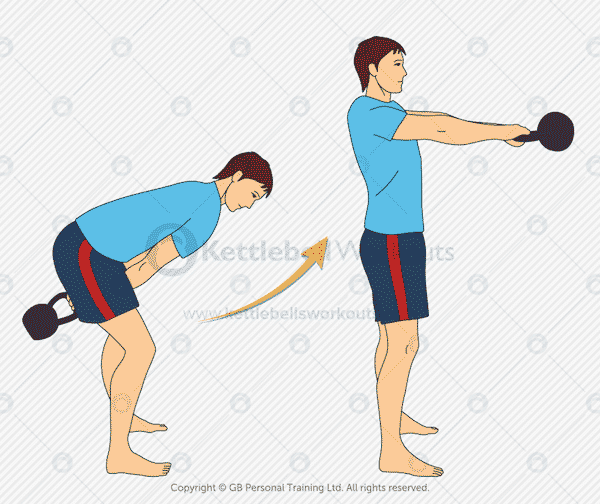
1. Two-Handed Kettlebell Swing
The Swing teaches explosive hip extension. Learn the hip hinge first and let the hips create the movement rather than lifting the kettlebell with the shoulders.
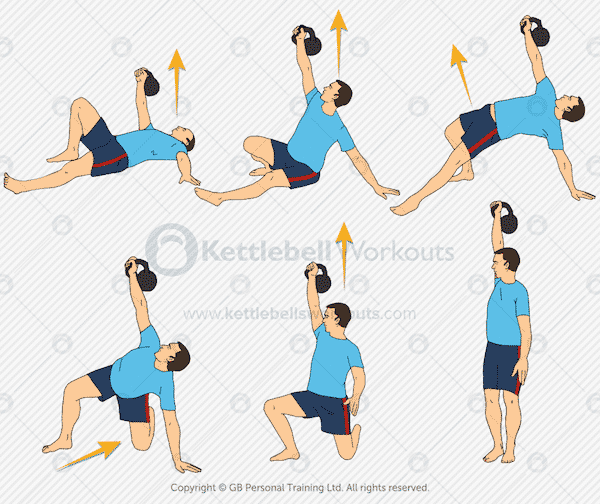
2. Turkish Get-Up
The Get-Up teaches you to control the kettlebell while moving from the floor to standing. Beginners can practise sections of the movement before attempting the full repetition.
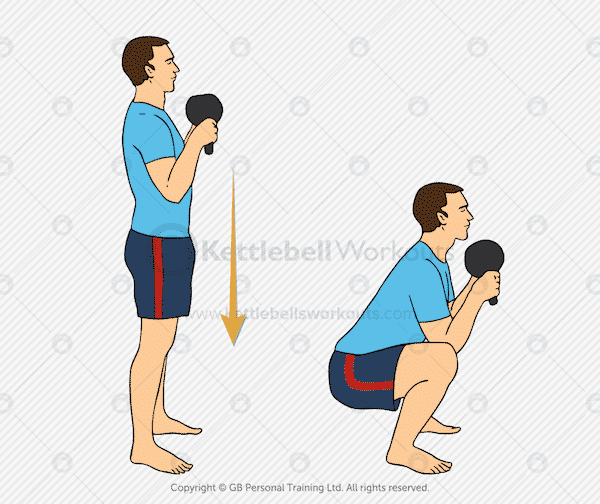
3. Goblet Squat
The Goblet Squat develops the knee-bend pattern while the kettlebell acts as a counterbalance in front of the body.

4. Reverse Lunge
The Reverse Lunge introduces single-leg control and teaches you to manage the kettlebell while the lower body works asymmetrically.
Your First Kettlebell Workout
Your first workout should be deliberately simple. The objective is to practise the movements, not prove how much fatigue you can tolerate.
Beginner Practice Workout
- Goblet Squat: 5 reps
- Two-Handed Swing: 10 reps
- Reverse Lunge: 5 reps each side
- Rest for 60-90 seconds
- Repeat for 3 rounds
If you are not yet comfortable with the Swing, replace it with a kettlebell Deadlift until your hip hinge is reliable.
How Often Should Beginners Train?
For most beginners, 2 to 3 kettlebell sessions per week is a sensible starting point. Three non-consecutive sessions, for example Monday, Wednesday and Friday, gives you regular practice while leaving recovery between harder workouts.
Short technique sessions can sometimes be performed more often, but do not confuse practising a movement with doing another demanding workout.
For a complete explanation of frequency and recovery, see How Many Kettlebell Workouts Per Week?.
How to Progress Your Kettlebell Training
Progress does not always mean buying a heavier kettlebell. You have several ways to make training more challenging while keeping technique under control.
Change one variable at a time. If you simultaneously increase the weight, repetitions, exercise difficulty and training frequency, it becomes difficult to know what your body is actually adapting to.
Common Beginner Kettlebell Mistakes
Where to Go Next
Once you understand the basics, use the pages below depending on what you need next.
Kettlebell Training for Beginners: Final Thoughts
Kettlebell training does not need to be complicated. Start with one suitable kettlebell, learn a small number of fundamental movements and give yourself enough time to become comfortable with them.
Build your training around movement quality first, then gradually add repetitions, volume, more difficult variations or a heavier kettlebell.
The beginner who learns the basics well has far more options later than the beginner who rushes straight to advanced exercises.
Frequently Asked Questions
Are kettlebells good for beginners?
Yes. Beginners can use kettlebells to develop strength, conditioning and movement skills with very little equipment. Start with basic patterns and progress gradually.
What weight kettlebell should a beginner use?
A broad starting range is 8-12kg for women and 12-16kg for men, but the right weight depends on the exercise, body size, training history and movement quality.
How many kettlebells does a beginner need?
One is enough to start. A second heavier or lighter kettlebell becomes useful later as your strength and exercise selection develop.
How often should a beginner do kettlebell workouts?
Two to 3 sessions per week is a sensible starting point for most beginners. Three non-consecutive sessions gives regular practice with recovery between harder workouts.
What kettlebell exercise should a beginner learn first?
Learn the hip hinge and kettlebell Deadlift before progressing to the Swing. The Goblet Squat, Reverse Lunge and sections of the Turkish Get-Up are also useful foundational movements.
Can you train with just one kettlebell?
Yes. One kettlebell can support a large range of exercises, and many movements can be progressed from 2-handed to single-sided variations before you need another weight.


I absolutely loved this kettlebell training guide! The videos really made it easy to understand the techniques, and I appreciate the clear step-by-step instructions for beginners. Can’t wait to start incorporating these exercises into my routine!
This kettlebell training guide is fantastic! The videos are super helpful for beginners like me. I love how you broke down the exercises and provided tips for proper form. Can’t wait to try these workouts!
hello sir, I have been a bad form powerlifter,bodybuilder, surfer,runner from 23years old till 1996,had a bad accident as a roofer[thrown off a almost 2 story buy alarge machine my left wrist ,shoulder are arthritic now. I sup paddle, surfing and race train, I am hurting now , with bad mobility in that shoulder. I am so loving your systems in kettle bell, just beginning. trigger points in my upper back are a big issue. Will I ever be able to over head exersize? I am 65 years old now. lmk plz. Will, Oahu north shore guy.
Hi, I just learned about this awesome program. I had an accident in 1996 at work. I got thrown off a building and my left shoulder, forearm and wrist got crushed. I like over head lifting but there’s arthritis in the joint and my mobility there is bad. I have trigger pt. pain down my trap and upper back and in front shoulder blade. I was sup distance paddling, but to stop that and surfing. can you give your thoughts for kettle bell work outs, please.
I’d be very careful Will and work through lots of mobility exercises to help rehab your joints. Usually, shoulders are happier when lifting stops at chest height so you should find the deadlift, clean, swings, squats etc. OK, just be careful with your wrist. I’d start with these 5 exercises and see how they feel.
thanks for help, I’ve been doing your stretching, mobility programs and they ARE helping more than anything else! Arigato friend. my shoulders are moving in your lat stretch slowly but definitely surely. I’m sooo happy. I just did 5 half get ups, your swing for 30, 30 rest. And I think I can be comfortable with those 5 workouts- the beginner program but I decided to go back and start from all the beginner programs. I think I’d rather kettlebell than surf lol! The halo is a little stiff though, any thoughts? Again thank you SO much. javelin126wej!
Hello,
Thank you for the website and the guides, they are wonderful. I have been Dx with multiple sclerosis, so balance is a real challenge. I have also loss over 200 pds and got up from a wheelchair. I am looking for excersises to get started with since movements like the Turkish get up are nearly impossible for me do, because of lack of balance. I would also be suggestions on movementsto help loss the fat, that is left after losing all the weight.
PS I have already turned two people to your website and again thank you.
Thanks Travis, I suggest you try these 5 beginners kettlebell exercises
What other workouts can we do after doing the 10 minute workout? Im trying to lose weight and feel like that may not be enough? Can I add in cardio to my day as well?
10 minutes is plenty Amanda if you are performing the workouts correctly. Make sure you are using the correct weight, at least an 8kg or a 12kg for two handed swings. More exercise is not always better.
If your main goal is fat loss then your diet will have a quicker impact than your exercise.
Sugar is the best place to start, reduce or eliminate all sugars (including artificial ones) especially sugar from alcohol.
Flour is the next best area to cut down and eliminate.
Keeping a food diary or journal has been proven to make a big difference. Each week try to improve on the one before.
Best of luck.
Love this article thanks for sharing.Would like to ask if I can replace the two handed swing with outside the leg one hand swing and also replace the get up with kettlebell press since I’m paraplegic in a wheelchair?
Good to hear from you Roy. It is hard for me to say without understanding more about your movement but ultimately you need to think about your goals. Certainly presses overhead are a simple option for developing shoulder and upper body strength. The swing may be more difficult as it is a hip based exercise and you don’t want to just turn it into a dynamic forward shoulder raise.
I’m doing 10 rounds of one arm swings for ten rounds and feels really good on my shoulders.I do have to use my other arm to hold one of the tires because my legs don’t work but are able to swing.Going to learn to get better at it before I move to the next exercise.Really like the way you explained how to progress many thanks love using kettlebells from my Apt.
I do have to alternate arms for 30 seconds total on the swings.
Greg hey,
Fantastic guides, thank you!
I started working out as per your beginner program about 2 months ago with a 16kg bell. I do all 3 exercises 6 days a week, as you suggest. I’m happy to report that last week I managed 11 sets of 35 secs (25 secs rest) of 2 handed swings with 24kg bell, almost 200 swings in 10mins.
Is it possible to contact you privately for further training advice?
Cheers,
Emil
Excellent, well done Emil, great progress. You can always contact me here
I turn 56in a couple days and I quit smoking in may of this year I have started exercising because when you don’t smoke you need to make serious changes in your way of life(extra time). my grand daughter has helped me with some equipment 2 kettle bells one 20# the other 30# honestly I’ve never heard of them till now. I’m looking on the interweb for exercises to do with them and I run across your web site. I’m going to start your beginner series Sunday evening. the thing that gets me wanting to do yours is you are not a no neck neanderthal you don’t scream into a microphone attached to your head and you explain how to do each move.you start with a warm-up then you say if this wipes you out just do this till you can do it and not have it kick your ass then just do this till you can do it then you add to that. looking at all the exercise websites you are the only one doing it that way.
Hi There !
Amazing guide! Great !
I’m 50, 1m75, 75 kg and I’m not new with force / muscle training in gym.
Now I’m training home with a Kettle bell 3 times a week.
I’m performing swing : 100 reps with 16 kg (single round)
After that I’m totally exhausted !
Do think this is worth continuing this way of should I switch to the 30 secs / pause 10 rounds format ?
Kind regards,
Phil
Thanks Phil, you could try 30 seconds of Swings then 30 seconds rest, repeat for 10 minutes if possible. Try this for a few weeks, every other day, and then try the 100 swings again and see how you feel. Let me know how you get on.
Hello Greg!
My question is: this 10-minutes workout can be performed on the morning?
Thanks
Sure can Efim
its always morning somewhere
great article!
exactly what i need!
Great guide and easy to follow , can’t wait to get started and follow this !
This is the best beginner’s kettlebell resource I’ve found – respect! One question if I may – I’ve been doing arm bars and windmills as part of my own kettlebell workout. Would you say it’s better to do them before or after the other exercises?
Depends on how hard you are going to work them Paul, you don’t really want to exhaust your shoulder stabilisers before a workout. You could do a few light, easy ones as a warm up and work them a little harder at the end.
Ciao Greg,
I’m writing from Italy, sorry for my English.
I have read your beginners guide to kettle bell workouts, and I have found it totally perfect. Can you, please, tell me the schedule for the weekly workout once I will be able to make the 4 exercises?
Thank you,
Marco.
Ciao Marco, thanks for your interest in my kettlebell training. Once you can complete all 4 exercises then you can move on to my 25 best beginner workouts. Enjoy!
Hi Greg
You have provided an excellent warm up routine, do you have any recommendations for a post workout stretching/cooldown programme? Apologies if it is on the site and I have missed it.
I am 69 years old and I would like to confirm that working with kettlebells over the last two years has massively improved my strength and balance – thanks.
Brian
Thank you Greg
As someone who has been told for a very long time that post exercise stretching is essential (gyms I have been to in the past almost made a ritual of it) I was delighted to find this quote from the page you linked to “Stretching after a workout will have little impact…”, I have often wondered whether it had any value. I will make time to some of the specific stretches that I feel will do me good particularly for my neck/upper back and my hip flexors.
Thanks again.
Best KB programs ever, from zero to advanced!
Thanks for the kind words John
Greg,
This is outstanding information you’re gifting us with. I am a Physical Therapy student, and the basis for all I’m learning is proper body mechanics and how to teach them to our patients. I can say without reservation that your videos and program are the very best I’ve found in terms of proper mechanics and educating the kettlebell user. Your basic program and videos are a HUGE gift to all of us who want to build a safe, effective kettlebell routine. As I progress in this activity, you are the source I will turn to for more advanced workouts.
Thank You again for getting me started right!
Richard H.
Greg, I am looking for the link to all of your kettlebell workout videos. I cannot find them anywhere. I was told in one of your emails that they were in one place now.
Here you go Moe, you can see all 52 kettlebell exercises here: https://kettlebellsworkouts.com/kettlebell-exercises/
Hi Greg
I have read your beginners guide to kettle bell workouts, can you clarify the warm ups, do I need to do all the warm ups before tackling your exercises.
thanks Greg I am really looking forward to starting.
Hi Terry, yes the warm up is very important. If you can’t make it through the warm up then use this as your workout and then slowly add the exercises onto the end as you progress. Keep me updated.
Exceedingly informative website and very good explanatory videos. Thank you for all the work you have put into this website. One suggestion would be to have all the videos under one section for quick reference even though they are posted as part of various workouts. This has become my new kettlebell resource!!!
Thanks Narendra, good suggestion, I’ll add that to my list.
Thanks Greg,
this guide will help me convince my wife to start training… I hope. Your writing style is informative but written in plain English without all the complicated terminology and scientific explanations as one often sees elswhere. This is exactly what beginners need. Nice job and I appreciate all the time and effort you put into your website – and completely free without any of the “enter your email here” nonsense! Thanks.
For anyone reading here who is unsure or has questions about anything to do with KBs, bodyweight training,rehab training or advice in general, I can say from previous experience that Greg is a true gentleman who answers emails with sound advice and suggestions. Again, thanks Greg.
Thanks for the kind words John, yes I’m always here to help – all the best.
This is the best kb intro guide I have ever come across – thank you! Am sharing on my social media. I have an acl knee strain for 9 months – it is much better now after 6 months rest, rehab exercises, and 3 months piyo – but still it is often sore and its number one in my mind when I train. Now that I’ve completed piyo I am looking for what next – am thinking barre work maybe – would love to get back to kb swings but not confident about that because of the high weight load swinging creates – but I am definitely going to incorporate the other exercises into my plan (squats, get-ups) and maybe one day I’ll get back to the swings – thank you.
Thank you so much. This beginner’s guide has really explained to me what I need to do to start getting on track with my health and workout goals.
Amazing Greg and thankyou! Very imformative and I have bought all your packages! Which one to start after the beginners though? Decisions decisions!
A* website
Brilliant, thanks Desta. How about the 12 week Women’s Program after the beginners?
Thankyou so much for all the info. I feel more confident working with my kettlebells now. Yr videos on technique our fantastic. Thankyou so much Greg for the time and effort you put into making us all feel more confident in what we are doing.
Kind Regards
Maria King
Greg – this is an impressive amount of fabulous information! Thank you …,
Kettlebells are the only exercise modality I’ve managed to stick with for any period of time because there are fun, there are so many different exercises that one can do (never boring) and they work! During the learning phase you have been my reference.
I work in a fitness store selling fitness equipment and products. When someone asks about kettlebells I always tell them to go to your website and this takes it to a whole new level – the URLs is going on my phone and will be passed out to anybody looking for high-quality information.
Can I mention that I’m a senior?
That sounds great Richard, thanks for sharing the info. If ever you need anything, just drop me a line. All the best.
I am a complete beginner, and hate to admit that I have a set of kettle bells gathering dust for the last year, mainly because I didn’t really know how best to use them.
This guide is a great help and I am looking forward to starting using them now I have a bit more knowledge!
Thanks for the great guidea
Hi Greg,
I found your website by looking for a KB App and I’m really impressed about the quality and quantity of information you give us on your website. One year ago I started my workouts with kettlebells with the help of a book, but with your good videos and explanations it’s easier for me to see where I still make mistakes. And I like your programs …also those of your App.
Kind Regards from Germany
Glad to be of service Heike, if ever you need any help just let me know.
Great write up Greg, an incredible resource for beginner and veteran alike! Well done.
Thanks James, pleased you found it useful.
Thanks for the quality of informations you give us. It’s very very helpful!!!
Hi Greg
I use kettle bell but unfortunately have picked up 2 hernias in last 2 years ( not necessarily related) . What advice can you give with respect to 1) use of kettle bells with people who have history of hernias, 2) general fitness recovery advice after hernia ops
Many thanks
John
Sorry to hear this John, it will depend on where are what type of hernias but the dynamic strain that kettlebells put on the body would not be a good fit for you right now. You will need to seek out someone to personally assess and monitor your fitness training and the way you load your body. Recovery varies from one person to the next depending on your diet, job, age, activity levels etc. I would certainly be starting with just bodyweight exercises when you feel you are ready. Take care.
I cannot believe the amount of quality info Greg is giving away here #respect
Thanks Ted, I hope it helps you get the results you are looking for. All the best.