
Last Updated on 11 August 2026 by Greg Brookes
The kettlebell High Pull is a fast, technical exercise that sits naturally between the One-Handed Swing and the Snatch.
Although it is called a pull, I do not use the High Pull as a primary back-strength exercise. Most of the kettlebell’s momentum should come from the hip drive. The upper body controls and redirects that momentum rather than trying to muscle the kettlebell upwards.
Where the High Pull really excels is conditioning. Once your timing is good, repeated High Pulls can raise the heart rate quickly while also challenging coordination, grip and control.
What Is a Kettlebell High Pull?
A kettlebell High Pull begins like a One-Handed Swing. As the kettlebell rises from the hip drive, you guide the elbow high and back so the bell travels towards the side of the body. The handle, forearm and shoulder should feel connected rather than separated. You then actively push the kettlebell forwards again so it rejoins the swing arc.
How to Do the Kettlebell High Pull
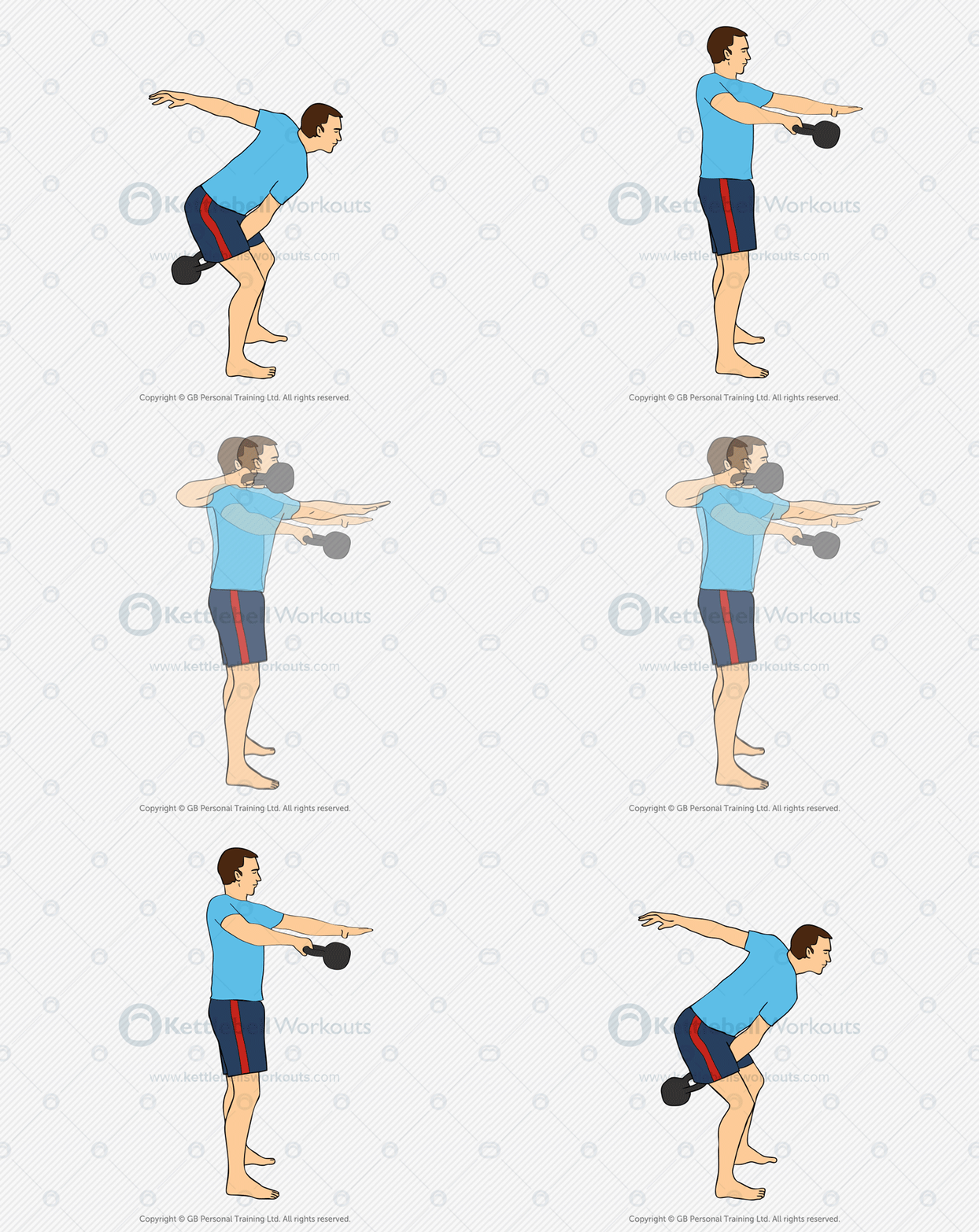
- Start with a strong One-Handed Swing and let the hips create the power.
- As the kettlebell rises towards chest height, bend the elbow and guide it high and back.
- Keep the wrist reasonably straight and line the kettlebell handle up with the forearm.
- Aim to create one connected line through the kettlebell, forearm and shoulder rather than letting the bell float away from the arm.
- At the top, do not pause or try to hold the kettlebell in position.
- Actively push the kettlebell forwards again so it returns smoothly to the swing path.
- Allow the arm to lengthen before the kettlebell drops back between the legs for the next hip drive.

Kettlebell High Pull Muscles Worked
The High Pull uses muscles throughout the body, but it is important to understand the difference between a muscle being involved and that exercise being the best way to strengthen it.
These provide most of the power through the hip hinge and explosive hip extension.
The trunk controls the body as the kettlebell accelerates, changes direction and moves on one side.
The traps, rhomboids, rear deltoid and other shoulder muscles help guide and control the kettlebell during the High Pull.
The hand and forearm are important for maintaining the bell’s path and controlling the transition back into the swing.
Kettlebell High Pull Benefits
The main reason I programme High Pulls is not to add another back exercise. It is to progress a strong One-Handed Swing into a more demanding movement that requires greater timing and control.
- Excellent cardiovascular challenge. The continuous hip drive and arm action can increase the heart rate very quickly.
- Develops timing and coordination. You have to redirect a moving kettlebell at exactly the right moment.
- Progresses the One-Handed Swing. It adds another skill without yet taking the kettlebell overhead.
- Prepares you for the Snatch. Learning to keep the bell close and control its path is useful before progressing overhead.
- Challenges grip and shoulder control. The arm must stay connected to a fast-moving kettlebell throughout each repetition.
Common Kettlebell High Pull Mistakes
Most High Pull problems are timing problems rather than strength problems.
- Trying to pull the kettlebell up with the arm. Let the hips create the momentum first, then redirect it.
- Elbow too low. A low elbow often leaves the bell hanging below the forearm and creates the disconnected position that makes the exercise feel awkward.
- Kettlebell separated from the forearm. At the top, think about the handle, forearm and shoulder moving together rather than the bell floating independently.
- Waiting at the top. The High Pull is a continuous movement. Redirect the kettlebell immediately rather than trying to hold it beside the shoulder.
- Letting the bell simply drop. Push it forwards again before gravity takes over so the return to the swing stays smooth.
- Grip too loose at the wrong moment. You do not need to crush the handle for the whole repetition, but the hand must be secure while you redirect the kettlebell.
- Learning with too much weight. Heavy kettlebells magnify every timing error.
How to Learn the High Pull
I would not teach the High Pull until the One-Handed Swing is already comfortable. If the swing is inconsistent, adding a pull usually makes the problem worse.
A simple practice set might be 3 One-Handed Swings followed by 1 High Pull. Repeat that sequence several times on one side, rest, then change arms. Gradually reduce the number of swings between High Pulls as your timing improves.
Only after you can perform smooth consecutive High Pulls would I consider progressing towards the Kettlebell Snatch.
Kettlebell High Pull Cardio Workout
This is where I think the High Pull really earns its place. Because it combines repeated hip extension with a technical upper-body action, you can create a substantial cardiovascular challenge without needing a complicated workout.
High Pull Intervals
- High Pull, left: 20 seconds
- High Pull, right: 20 seconds
- Rest: 40 to 60 seconds
- Repeat: 4 to 6 rounds
Use a kettlebell that lets you maintain the same clean path from the first repetition to the last. Once fatigue causes the elbow to drop, the bell to disconnect from the forearm or the return path to become uncontrolled, the set is finished.
If 20 seconds is too demanding technically, start with 5 controlled repetitions per side rather than working against the clock.
High Pull vs Swing vs Snatch
These 3 exercises belong to the same ballistic family, but they have different technical demands.
For most people I would learn them in exactly that order: One-Handed Swing → High Pull → Snatch.
Where the High Pull Fits in Your Training
Use the High Pull when you want more technical and cardiovascular demand than a basic Swing, but do not mistake it for a replacement for controlled strength work.
If you want stronger glutes and hamstrings, load your Deadlifts and other hinge exercises. If you want a stronger back, use Rows and Pull-Ups. If you want to develop explosive kettlebell conditioning, timing and coordination, the High Pull is an excellent choice.

Frequently Asked Questions
What muscles does the kettlebell High Pull work?
The glutes and hamstrings create most of the power. The core, upper back, rear shoulder, forearm and grip help control and redirect the kettlebell. I would not use the High Pull as a primary back-strength exercise because much of the movement comes from momentum generated by the hips.
Is the kettlebell High Pull good for cardio?
Yes. Once your technique is reliable, continuous High Pulls can raise the heart rate quickly and work well in short intervals or conditioning circuits.
Why does my kettlebell High Pull feel awkward?
Usually because the timing or alignment is off. Keep the elbow high and try to connect the kettlebell handle, forearm and shoulder rather than letting the bell float away from your arm.
Should I pull the kettlebell with my back?
No. The hips should create most of the momentum. The upper back and shoulder help guide and control the kettlebell rather than trying to haul it upwards from a stationary position.
What weight should I use for the High Pull?
Start considerably lighter than the weight you normally use for swings. Choose a kettlebell that lets you practise the path, elbow position and push-out without fighting the load. Increase weight only when the movement remains smooth.
Should I learn the High Pull before the Snatch?
Yes, that is the progression I prefer. A strong One-Handed Swing comes first, followed by the High Pull, and then the Snatch once you can control the kettlebell path confidently.


What about double kb high pull, is there some diference between single or double?
Yes you can perform a double high pull but it is not easy as the kettlebells need to swing in between the legs. If you use just 1 kettlebell then you get more rotation and thus strengthen the core muscles in a different way. Personally I never use or teach the double high pull.
What’s the consensus if any on a two handed high pull with heavier weight?
Not a great idea Vedant for these reasons
Is it possible if I can email you what I have been doing because I am not doing the upright row and I have questions on whether it can be implemented because I have not found anything online of what I am doing
Sure thing Vedant
Hi Greg,
I follow you with great interest, but I must admit I am very cofused here.
In most of the high pulls videos I find around, people start to pull their elbow up, at approx 45 degrees with horizon, as the bell past the knees.
Your video is different.
You pull horizontally and when the kb reaches the top.
Are these 2 different variations of same exercise?
Thanks a lot.
Good to hear from you Claudio. My high pull variation works more into the mid-back rather than the upper back which is often overstressed in daily life and also abused in the gym.